What Is Food Texture Analysis and Why Does It Matter?
At Bareiss, we help food producers, packers and labs put numbers on something people usually describe with adjectives: how firm, hard or soft a product is. We have been doing this since the company was founded in 1954, and we have sold products in North America for more than 40 years. Our work now spans food, pharma, and plastics and elastomers.
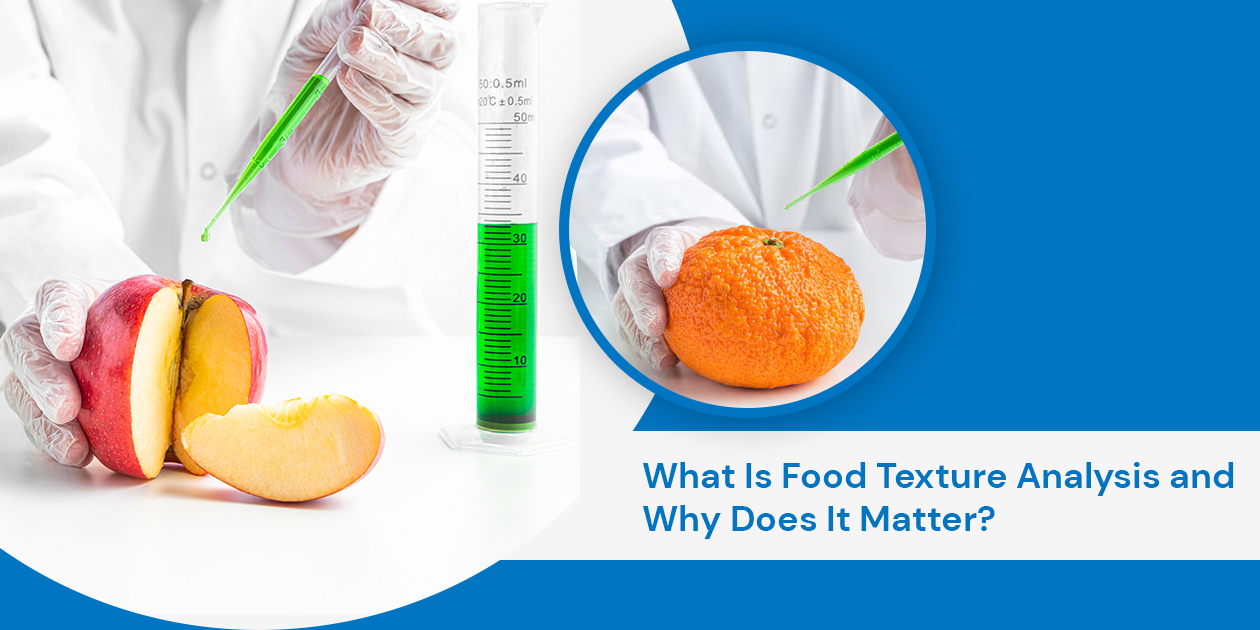
Food texture analysis is the objective, instrument-based measurement of the physical properties people feel when they handle, bite or chew a food. A food texture analyser applies a controlled force and records how the product responds in force, deformation and time. The results turn subjective words like “crisp” or “firm” into numbers you can compare, repeat and put in a specification.
Some of those measurements, such as flesh firmness, can be taken without damaging the product. Our fruit hardness tester is built for exactly that. For other materials, our wider range of hardness testing instruments covers food, pharma and elastomers.
What does “texture” mean?
Texture is not a single property. The international sensory vocabulary standard ISO 5492 describes it as the mechanical, geometric and surface properties of a product that sensory receptors can perceive. In practice, that covers:
- Mechanical attributes: hardness, cohesiveness, springiness, adhesiveness
- Geometrical attributes: particle size, shape and structure (for example grainy or fibrous)
- Surface and body attributes: moisture and fat content (for example oily or moist)
ISO 11036 sets out a method for building a texture profile of food products, covering solids, semi-solids and liquids, by classifying mechanical, geometrical and surface attributes. That method is sensory, meaning a trained human panel does the evaluation. Instrumental texture analysis is its measurable counterpart.
Why food texture analysis matters?
Quality control. Texture influences how products are processed and handled, how long they stay stable during shelf life, and whether consumers accept or reject them.
Product development. Texture instruments are used in product development, product substitution and quality control. Ripeness and freshness. For fruit and vegetables, flesh firmness is a key ripeness indicator. Pulp firmness is a reliable indicator of ripeness, and it helps monitor freshness and manage storage and transport capacity.
Reducing waste. Non-destructive testing means the tested fruit can still be sold or eaten. A shared language. Texture profile analysis gives food scientists, vendors, sales staff and customers a common language.
How a food texture analyser works?
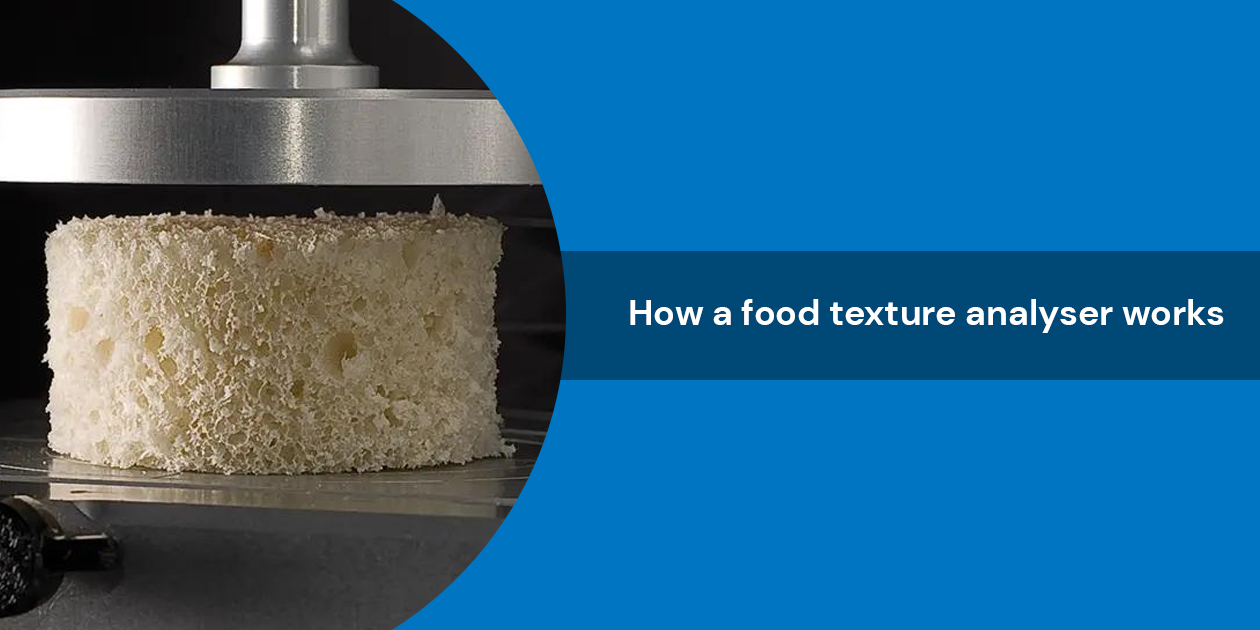
The principle is simple: a probe or fixture moves against the sample while a load cell records force. The sample sits on the base, and the arm moves down to compress or penetrate it, or upward for tensile testing. Typical test types include compression, penetration, cutting or shearing, extrusion and tensile (pull) tests. The probe geometry matters, so a wide range of jigs and fixtures simulates the real-world action being tested.
Texture Profile Analysis (TPA): the “two-bite test”
TPA is the best-known method in food texture analysis. It is also called the “two-bite test” because it mimics the biting action of the mouth. The sample is compressed twice and the force curve is analysed.
Where it came from?
Alina Szczesniak developed the original parameters at General Foods in the early 1960s. Her work showed strong correlations between instrument readings from the General Foods Texturometer and sensory judgments.
The foundational paper is Friedman, Whitney and Szczesniak, Journal of Food Science, 28, 390–396 (1963). It introduced five independent parameters (hardness, cohesiveness, adhesiveness, viscosity, elasticity) and three dependent ones (brittleness, chewiness, gumminess).
In 1978, Bourne adapted a universal testing machine to perform TPA by compressing standard-sized samples twice. His paper is Texture Profile Analysis, Food Technology, 32:62–66.
Common TPA parameters:
| Parameter | How it is defined in TPA |
| Hardness | The peak force during the first compression cycle |
| Cohesiveness | The ratio of the positive force area during the second compression to that of the first |
| Gumminess | Hardness × cohesiveness |
| Chewiness | Gumminess × springiness |
Over time, terminology has also evolved. “Elasticity” became “springiness” because elasticity already had rheological and engineering definitions.
Sensory vs instrumental texture analysis:
Neither method replaces the other. A food can hit a target hardness and springiness value and still fail if consumers do not like it or it does not match their expectations for that food. Sensory panels capture what people experience. Instruments give fast, repeatable data that is far cheaper to run at scale. Sensory evaluation is the ideal, but it is time-consuming and expensive to conduct. Most quality teams use instruments for routine testing and calibrate them against sensory results.
Food texture analysers: the main types
The market splits into two broad groups. Universal benchtop analysers run many test types with interchangeable probes. Specialised firmness and hardness testers are built for one job. Here is how they compare:
| Option | Type | Characteristics |
| Bareiss HPE III Fff | Handheld, non-destructive firmness tester | Built for fruit, vegetables, meat and fish. Integrated compression sleeve for correct positioning and pressure, automatic test start, stores up to 300 readings, exports over RS-232/USB, interchangeable test anvils |
| Other analysers | Universal benchtop | Run many test types (compression, penetration, shear, extrusion, tensile) using interchangeable probes and fixtures, and can produce full TPA curves |
Universal analysers are the right choice if you need full TPA curves, tensile tests or extrusion tests. A dedicated firmness tester is the better fit if your main question is “is this batch ripe enough, and can I test it without destroying it?”
How we approach food texture testing at Bareiss?
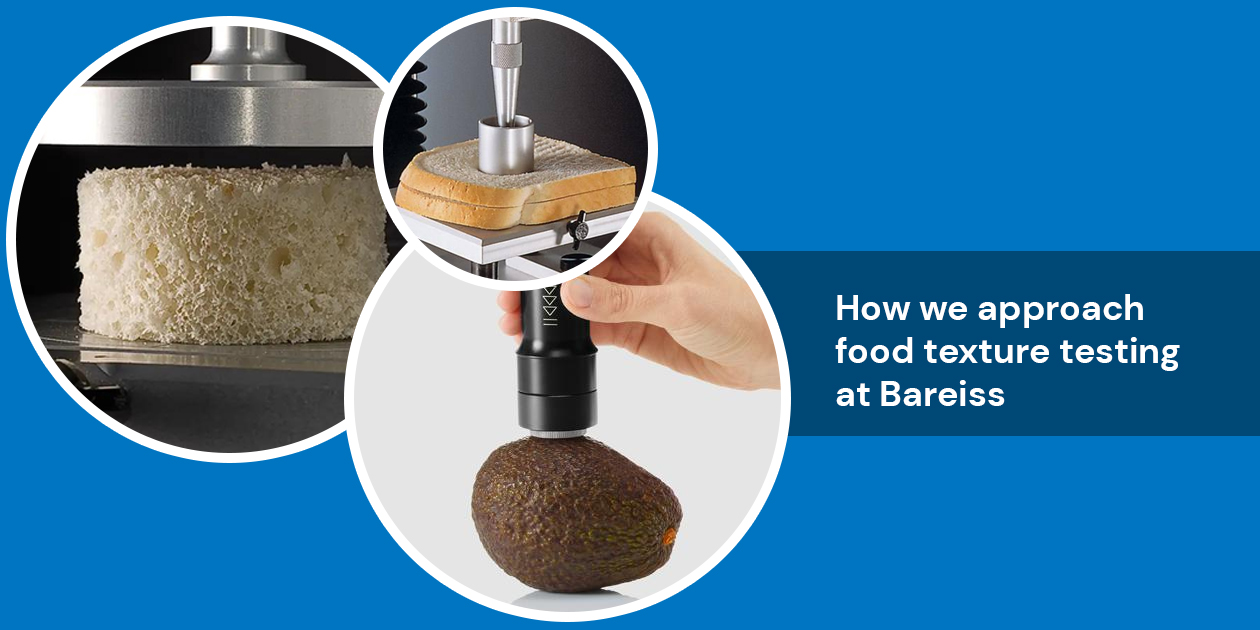
Bareiss was founded in 1954 in Upper Swabia, Germany, and our material testing specialists now support customers across North America from our Stouffville, Ontario office. It is a family business, run since 2017 by the third generation of owners. We focus on hardness and firmness, and our food range is built around the Fff (fruit firmness) test method.
What the HPE III Fff does?
It is a non-destructive hardness tester for fruits, vegetables, meat and fish, so you can assess ripeness and firmness without peeling or cutting.
- An integrated compression sleeve supports correct positioning and pressure. The test starts automatically, and an acoustic signal marks the end of the measuring time.
- It stores up to 300 readings, which can be exported over an RS-232/USB interface.
- Interchangeable test anvils let you test in a range of environments.
- An option records ambient temperature and relative humidity, with the data shown on a large illuminated display.
For labs, our hardness testing instruments also include the digi test II, a modular, fully automated system. Our German datasheet positions it as a fully automatic alternative to manual fruit firmness testing with minimal operator influence.
We want to be transparent about scope: we are specialists in hardness and firmness testing, not a full TPA supplier. If you need two-bite TPA curves, a universal analyser is the right tool, and we will tell you so.
Real-world example: replacing penetrometers
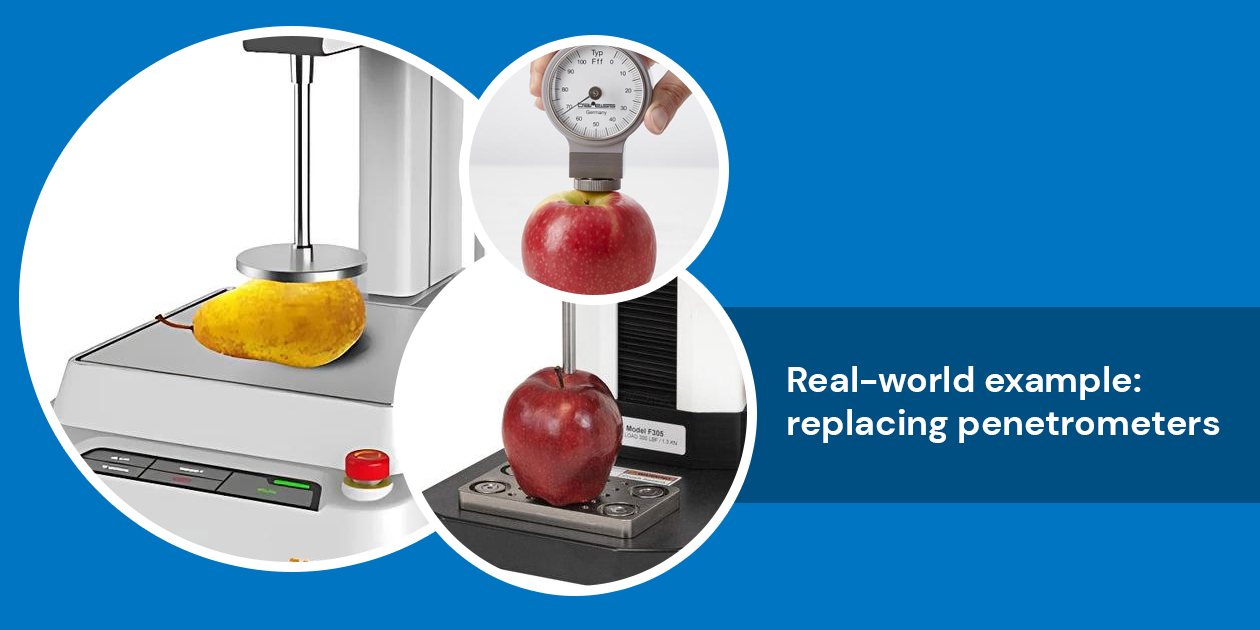
At the Canadian Institute of Food Science & Technology event at the University of Guelph on June 1, 2022, one of our North American distributors, Geneq Inc. of Montréal, introduced the HPE III Fff. The key point was the comparison with a traditional penetrometer: the Bareiss device is non-destructive, whereas a penetrometer damages the fruit to obtain a measurement. Attendees showed strong interest in moving to non-destructive testing to cut costs. This is our own account of the event and not an independent study, so we are not claiming specific savings figures.
How to choose a food texture analyser?
- Define the question. Ripeness grading, a full texture profile, or batch-to-batch QC?
- Match the test to the food. Compression suits bread, penetration suits fruit, and shear or cutting suits meat and noodles.
- Check non-destructive needs. If tested units must stay sellable, avoid destructive methods.
- Look at calibration and traceability. Calibration certificates matter for audit-ready QC. Bareiss Prüfgerätebau operates a DAkkS calibration laboratory, as shown on our datasheets.
- Plan for data. Check export options, storage capacity and software.
Frequently Asked Questions
It is the instrumental measurement of the mechanical properties of food, such as hardness, cohesiveness and springiness, by applying controlled force and recording the response.
Under ISO 5492, texture covers the mechanical, geometric and surface properties of a food that sensory receptors can perceive.
Parameters commonly include hardness, cohesiveness, springiness, adhesiveness, gumminess, chewiness and fracturability.
It is a double-compression test, known as the “two-bite test”, that extracts several texture parameters from a single force-time curve.
Yes, with a non-destructive firmness tester such as the HPE III Fff, which measures flesh hardness without peeling or cutting.
They answer different questions. Instruments give repeatable numbers, and sensory panels capture consumer perception. Many labs use both.
Food, pharmaceuticals, cosmetics and plastics. Bareiss devices are primarily used in the food, pharma and plastics and elastomers industries.