Product Overview:
A tablet hardness tester measures the force required to break a pharmaceutical tablet — formally called tablet breaking force — and is one of the standard in-process and release tests in solid dosage manufacturing, defined in USP General Chapter 〈1217〉 and European Pharmacopoeia 2.9.8.
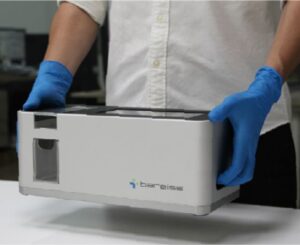
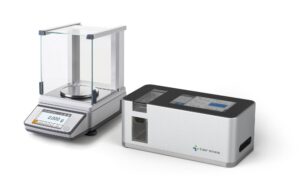
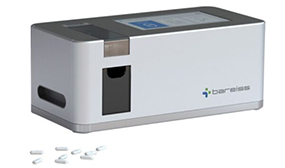
We designed the THT500 as a semi-automatic, five-parameter benchtop instrument backed by over 70 years of precision measurement engineering. It measures breaking force, diameter/length, width, thickness, and weight (via external RS232 balance) in a single test cycle, helping QC labs confirm that every batch meets pharmacopeial standards before release.
The pharmaceutical testing equipment market is growing at roughly 7.5% CAGR through 2033, with tablet and friability testers representing about 22% of that market — the second-largest category after dissolution testing (Spherical Insights, 2025). As batch volumes rise and regulatory scrutiny tightens, labs are replacing manual spring-based testers with automated instruments that eliminate operator variability. That shift is exactly what the THT500 is built for.
The THT500 tests one tablet at a time with manual loading. It is not a fully automated batch-feed instrument and does not integrate with tablet presses for in-line testing. We designed it for labs where measurement precision and flexibility across tablet shapes matter more than throughput automation.
Key Specifications:
| Specification |
Detail |
| Measuring Principle |
Breaking force, diameter/length, width, thickness, weight (5 parameters) |
| Force Range |
3–500 N |
| Force Measurement Accuracy |
±1 N |
| Measurement Methods |
Constant Force (10–200 N/sec) and Constant Speed (0.01–3 mm/sec), both programmable |
| Diameter / Length / Width / Thickness |
1–36 mm, 0.01 mm resolution |
| Weight Measurement |
External balance via RS232 (real-time sync) |
| Units |
Newton (N), Kilogram-force (kgf), Pound-force (lbf) |
| Display |
7-inch graphical touchscreen (English, Chinese) |
| Data Connectivity |
2× USB 2.0 |
| Power Supply |
100–240 V, 50/60 Hz, 90 W |
| Dimensions (W × D × H) |
320 × 155 × 130 mm |
| Weight |
Approx. 9.5 kg |
| Construction |
26 mechanical parts, 95% recycled aluminum housing, stainless steel on load-critical parts |
| Software |
Celeste (21 CFR Part 11 compliant) |
| Certifications |
ISO 9001:2015 (since 2003), ISO 14001:2004 |
| Calibration |
Annual; DAkkS-accredited lab, ISO/IEC 17025:2018 |
| Design Recognition |
Red Dot Design Award 2024 |
| Warranty |
3 years |
Multi Parameter Measurement
THT500 has 5 measuring parameters. Breaking force, diameter/length, width, thickness, and weight — captured in a single test cycle. QC teams generate a complete physical profile per tablet without transferring samples between instruments.
High Precision Load Cell
An electronic load cell delivers ±1 N accuracy with strong linearity across the full 3-500 N range. Small hardness differences between tablets are measured reliably rather than smoothed over by mechanical hysteresis — critical when QC teams need confidence that borderline readings reflect actual tablet properties.
Dual Measurement Principles
The THT500 supports both Constant Speed (0.01–3 mm/sec) and Constant Force (10–200 N/sec) methods, both programmable. USP 〈1217〉 references constant velocity as the standard approach, but some legacy methods and formulation protocols require constant force. Supporting both means labs migrating from older testers can maintain historical trend comparability, and multi-site studies can standardize on whichever method the protocol specifies.
Sample Alignment
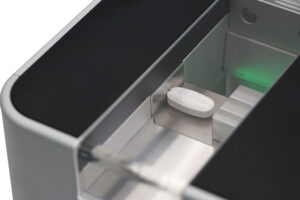
A dual sided guiding plate — flat for standard round tablets, grooved for curved, bi-convex, or oblong shapes — keeps samples properly oriented without manual alignment. Consistent positioning eliminates one of the most common sources of measurement variability in hardness testing.
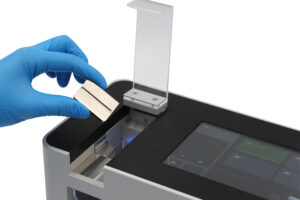
A transparent hatch provides full visibility of the test process, and an automatic abort triggers if the hatch opens mid-test (safety interlock).
Touchscreen Interface
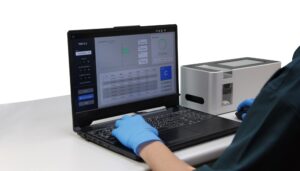
A 7 inch graphical touchscreen handles test creation, execution, and review. Status indicator lights (standby, normal, abnormal) give at-a-glance machine state without reading the screen. Side perforations in the housing support transport handling and internal air circulation.
Tablet Shape Versatility
The adjustable jaw system and programmable test speed accommodate tablets from 1 mm diameter compact immediate-release formats to large oblong sustained-release tablets, including round, bi convex, film-coated, effervescent, chewable, and irregular specialty shapes.
GMP Design and Maintenance
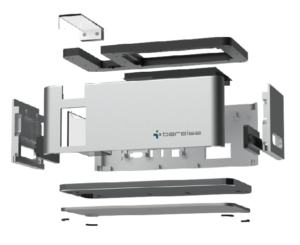
Tablet testing generates powder debris with every broken sample. The THT500 addresses this with a built-in disposal bin, an open visible test chamber for easy cleaning verification, and a minimal 26 part mechanical design that reduces debris collection points. Housing is aluminum alloy; stainless steel on load-critical parts.
Calibration is required once per year, takes seconds using the included external calibration device, and is backed by our DAkkS-accredited calibration laboratory (ISO/IEC 17025:2018).
Data Integrity and 21 CFR Part 11
Our Celeste software provides the full data integrity framework for regulated environments: audit trail with user access controls and password security, electronic signatures without modification of original records, database backup and restore, ODBC-based data mapping, CSV/PDF/XML exports, version control, and IQ/OQ/PQ validation documentation.
For basic documentation needs, USB export to CSV works independently of Celeste.
Hardness Testing in the QC Workflow
Tablet hardness is not an isolated measurement. It sits alongside friability testing (USP 〈1216〉), disintegration testing (USP 〈701〉), and dissolution testing (USP 〈711〉) in a complete quality control profile. Hardness confirms resistance to direct force; friability confirms resistance to cumulative abrasion. Together, they predict whether a tablet will survive the supply chain while still releasing the active ingredient as intended. The THT500 handles the hardness side of that pair.
Compression force is the primary process variable affecting hardness. When readings fall below target, the root causes are specific: granulation moisture too high, incorrect punch depth, or inadequate blending — each pointing to an actionable correction on the production floor.
Applications of Tablet Hardness Tester
Manufacturing
Operators sample tablets during compression to confirm hardness stays in spec, enabling real-time process adjustments that reduce waste before packaging.
R&D
Formulation scientists study how compression settings, excipient ratios, binder concentrations, and moisture content affect mechanical strength — data essential for balancing durability with disintegration and dissolution performance.
Quality Control
The THT500 verifies batch strength against release specifications with digital records that simplify regulatory submissions and audit preparation.
Nutraceutical
Vitamin and supplement manufacturers confirm tablet durability through transport against their own quality specifications.
Regulatory Compliance
The THT500 tests according to USP 〈1217〉, Ph. Eur. 2.9.8, and Japanese Pharmacopoeia methodology. With Celeste software, it supports FDA 21 CFR Part 11 compliance. CE marked and RoHS compliant.
We hold ISO 9001:2015 (quality management, since 2003) and ISO 14001:2004 (environmental management). Our calibration laboratory is separately DAkkS-accredited to ISO/IEC 17025:2018.
How It Works
The THT500 applies force through an upper jaw at a controlled, programmable rate while a load cell measures continuously. At fracture, the instrument records the peak force — the tablet’s breaking force value
Our Heritage: Testing Solutions Since 1954
Heinrich Bareiss founded this company in 1954 to build precision mechanical hardness testers. Over seven decades and three generations of family leadership — now under Managing Directors Katrin Shen and Oliver Wirth — we built our reputation in elastomer testing, earned Germany’s first DKD calibration laboratory accreditation (1996), and expanded globally with facilities in Germany, Shanghai, Taipei, and Stouffville, Ontario.
The THT500 applies that same engineering discipline to pharmaceutical tablet testing. It earned a 2024 Red Dot Design Award, with the jury noting it “blends seamlessly into the laboratory environment” and “impresses with its high quality of use.” Designed at our Taiwan Technology facility by Shao Hsuan Lu, Jun Sheng Wu, Shih Yu Wang, and I An Kuo.
What’s Included:
THT500 instrument, external calibration device, Celeste software license (21 CFR Part 11), IQ/OQ/PQ validation documentation, USB cables, power supply, user manual, and 3 year warranty. External balance available separately (RS232).
Serving the Americas:
Bareiss North America Inc. | 155 Mostar St, Unit 6, Stouffville, Ontario, Canada
United States — FDA-regulated labs nationwide | Canada — Health Canada-compliant facilities, served from Stouffville | Mexico — COFEPRIS-regulated manufacturers | Brazil — ANVISA-compliant facilities | Colombia — INVIMA-regulated labs | Argentina — ANMAT-compliant facilities
888-570-5577 | info@bareiss-testing.com
Frequently Asked Questions
What hardness should a pharmaceutical tablet have?
No single target — it depends on formulation and function. Typical compressed tablets fall around 40–100 N.
How does a tablet hardness tester work?
Force is applied through a jaw at a controlled rate; a load cell records the peak force at fracture. That reading is the tablet’s breaking force.
What unit measures tablet hardness?
Newton (N) is the pharmacopeial standard. Some instruments also report in kiloponds (kp) or kilogram-force (kgf).
What affects tablet hardness during manufacturing?
Compression force is the primary driver. Granulation properties (particle size, binder concentration, moisture), compression speed, dwell time, tablet geometry, and lubricant level also contribute.
How many tablets should be tested per batch?
USP and Ph. Eur. do not specify an exact number. Most labs test at least ten tablets per batch.
Does the THT500 measure more than hardness?
Yes — breaking force, diameter/length, width, and thickness in one cycle, plus weight with an external balance. Five parameters total.
Is the THT500 21 CFR Part 11 compliant?
Yes, with Celeste software — audit trails, electronic signatures, user access controls, IQ/OQ/PQ validation.
What is the difference between hardness and friability testing?
Hardness (USP 〈1217〉) measures the force to fracture one tablet. Friability (USP 〈1216〉) measures weight loss of a batch after tumbling. Both are needed; the THT500 handles hardness. Friability requires a separate friabilator.
How often does the THT500 need calibration?
Once per year. Takes seconds with the included calibration device. Our lab is DAkkS-accredited (ISO/IEC 17025:2018).