What Is a Rheometer? Rheology, Rheometry, and the Rheology Machine Explained
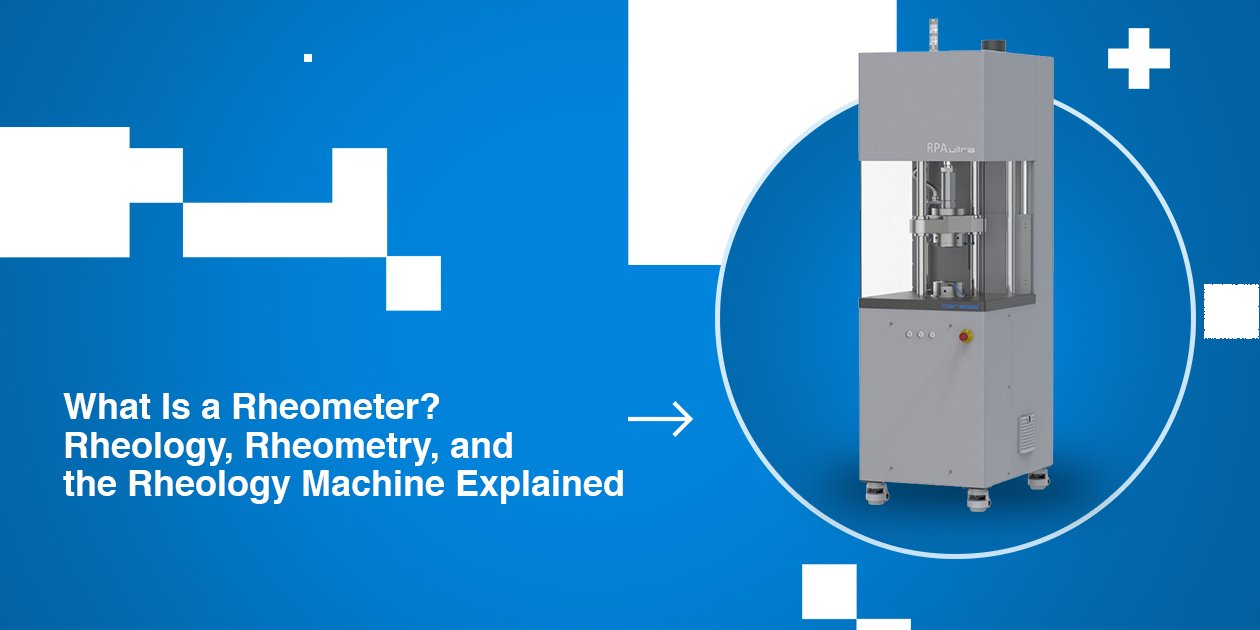
A rheometer is an instrument that measures how a material flows and deforms when a force is applied. The science behind it is called rheology, and the measurement practice is known as rheometry. In this guide, the rheology definition is explained, the meaning of rheological properties is clarified, and the viscometer vs rheometer question is answered. Our own rubber rheometer, the RPA Ultra, is covered in the second half.
Rheology and Rheometers at a Glance
| Term | Short answer |
| Rheology | The science of how matter flows and deforms |
| Rheological | Describes any property or behavior linked to flow and deformation |
| Rheometer | An instrument that measures flow and deformation under controlled stress or strain |
| Rheometry | The practice of measuring rheological properties with a rheometer |
| Viscometer | An instrument that measures viscosity, usually under simple flow |
| Rheology machine | A common search term for a rheometer |
What Is Rheology?
The definition of rheology is the study of how matter flows and deforms. The word comes from the Greek word for flow. Stress, strain, and time are considered together, so that liquids, soft solids, and everything in between can be described. Rheology is often called the science of the deformation of materials, as explained in this TA Instruments overview.
Everyday materials show why this matters. Water is poured quickly, and honey is poured slowly. Ketchup behaves differently again: it barely moves in the bottle until it is shaken or squeezed, and then it flows freely. Behavior like this is described by rheology, and it cannot be captured by a single number.
What Is the Meaning of Rheological?
“Rheological” is used as an adjective. The meaning of rheological is “relating to rheology,” so a rheological property is any property that describes flow or deformation. The most common rheological properties are listed below, and the full range is described by the University of Wisconsin materials facility.
- Resistance to flow caused by internal friction.
- A mix of liquid-like and solid-like response. Part of the applied energy is stored, and part is lost as heat.
- Yield stress. The minimum stress that must be applied before a material starts to flow.
- A drop in viscosity over time under shear, followed by recovery at rest.
- Creep and stress relaxation. How a material slowly deforms under constant stress, and how stress fades under constant strain.
What Is a Rheometer?
Searches for “what is rheometer” usually ask for one thing: a clear definition. A rheometer is a laboratory instrument in which a controlled deformation or force is applied to a sample, and the response is measured. Viscosity, elasticity, and flow behavior can be determined in this way. Samples range from dilute solutions to pastes, creams, molten polymers, rubber compounds, and asphalt. A broader technical background is given in this ScienceDirect topic page.
How a Rheometer Works
- A sample is loaded between two plates, or into a cone-and-plate or cylinder geometry.
- A steady or oscillating (sinusoidal) shear strain is applied by a motor.
- The resulting torque is measured by a transducer.
- Stress, strain, and viscosity values are calculated by software from the torque and motion.
- Temperature is controlled throughout, because rheological properties often change with temperature.
Two main test modes are used. In steady shear, a flow curve is produced that shows viscosity against shear rate. In oscillatory testing, a storage modulus (G′, the elastic part) and a loss modulus (G″, the viscous part) are reported.
What Is Rheometry?
Rheometry is the measurement side of rheology. Rheology supplies the theory, and rheometry is how that theory is tested in the lab. Deformation under an applied force is measured, and the results are used to characterize a material and predict its behavior. Because the behavior of many fluids changes with the size of the force, it is often too complex to predict, so it must be measured.
Rheology Machine: Types of Rheometers
“Rheology machine” is a common search term for a rheometer. Several designs are used, and the right one is chosen by the material and the question being asked.
| Type | How it works | Typical use |
| Rotational (parallel plate, cone and plate) | The sample is sheared between plates and torque is measured | Polymers, gels, pastes, coatings |
| Concentric cylinder | The sample is sheared in the gap between two cylinders | Thin liquids and suspensions |
| Capillary | The material is pushed through a narrow die and pressure is measured | Polymer melts at high shear |
| Extensional | The sample is stretched and its resistance is measured | Materials stretched during processing |
| Closed cavity (rotational) | The sample is sealed between heated dies that oscillate or rotate | Rubber and elastomers |
Viscometer vs Rheometer: What Is the Difference?
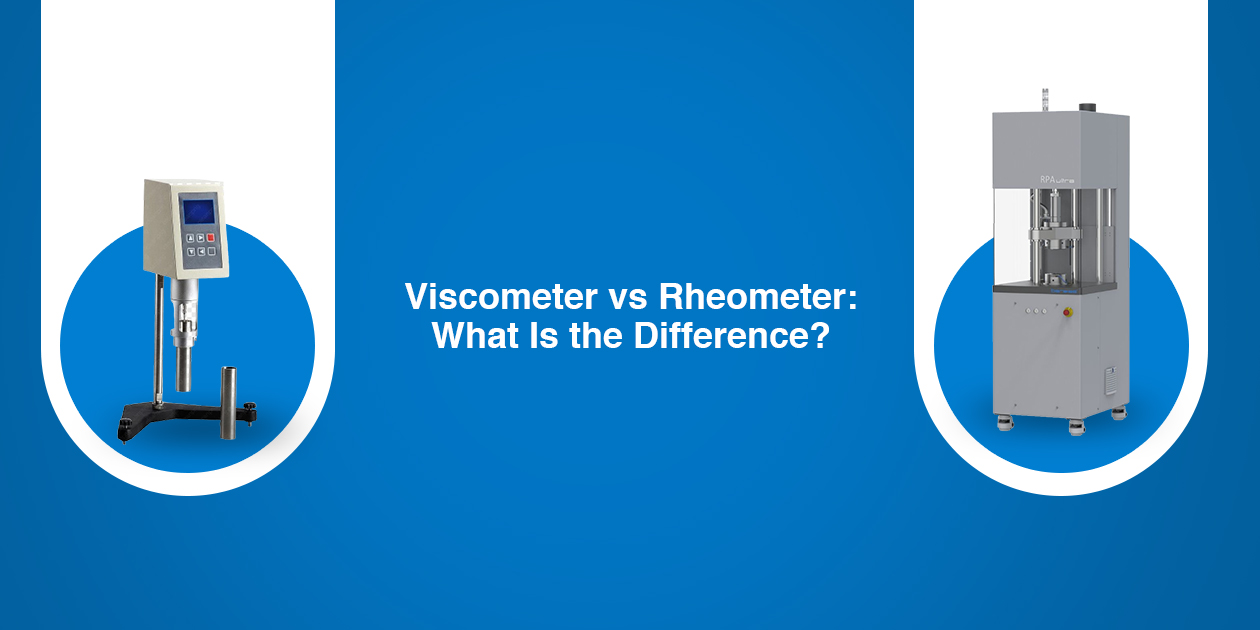
Viscometer vs rheometer is one of the most common questions in material testing. A viscometer measures viscosity, usually under a single flow condition. A rheometer measures viscosity too, but elasticity and time-dependent behavior are also covered, across a wide range of conditions.
| Feature | Viscometer | Rheometer |
| Main result | Viscosity | Viscosity, viscoelasticity, yield stress, creep, relaxation |
| Test modes | Mostly steady shear | Steady shear, oscillation, creep, stress relaxation |
| Control | Usually a set speed | Controlled stress or strain |
| Best for | Simple quality checks on liquids | Research, formulation, and complex materials |
| Cost and complexity | Lower | Higher |
A viscometer is chosen when one viscosity number is enough, such as when batches of a simple liquid are checked. A rheometer is chosen when behavior must be understood, such as when the shape-holding ability of a paste is predicted.
The type of fluid matters as well. Water is a Newtonian fluid, so its viscosity stays constant. Ketchup, paint, and polymer melts are non-Newtonian, so their viscosity changes with shear rate. A single viscometer reading can be misleading for these materials. In short, a rheometer can be used as a viscometer, but a viscometer cannot do the work of a rheometer.
Where Rheometry Is Used
- Texture and shelf life are evaluated. A TA Instruments note shows how the texture of yogurt is studied.
- Curing behavior is followed over time, as shown in this note on adhesive curing.
- Pharmaceuticals and personal care. Creams, pastes, and concentrated formulations are checked for stability and processing.
- Melts and compounds are tested for quality control and processing.
- Asphalt and construction materials. Flow and stiffness are measured at different temperatures.
- Rubber and elastomers. Cure behavior and processability are measured, which is covered in rubber rheometer guide and in wider rubber and plastic testing range.
How a Rheometry Test Is Performed
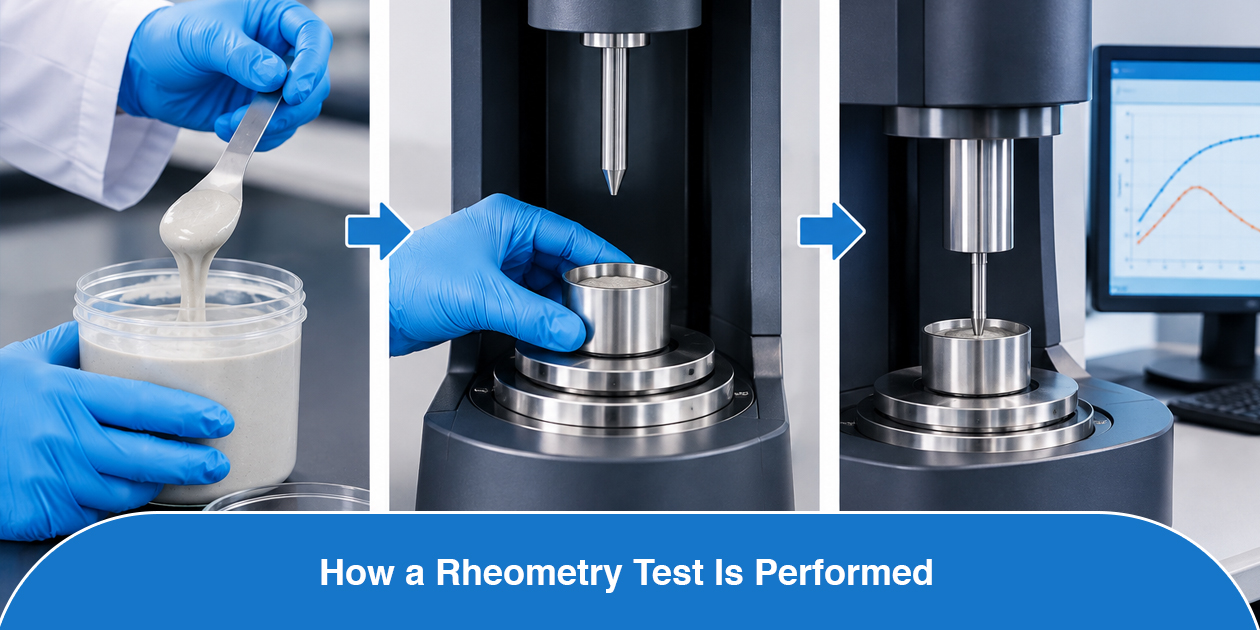
- The test mode and geometry are selected for the material.
- The sample is prepared and loaded, and any excess is trimmed away.
- The temperature is set and allowed to stabilize.
- A test is programmed, such as a flow curve, an amplitude sweep, a frequency sweep, or a time or temperature sweep.
- An amplitude sweep is normally run first, so that the linear viscoelastic region is found.
- Torque and motion are recorded, and the results are analyzed as viscosity curves or moduli.
Strengths and Limits of Rheometry
Rheometry is non-destructive, and a very wide range of samples can be tested with simple preparation. Limits exist as well. Samples are expected to be stable and fairly homogeneous, and sample stiffness must fall within the range of the instrument. At very high shear rates, above about 1,000 1/s, mechanical limits are met in many instruments.
Rheometers for Rubber: The Bareiss RPA Ultra
Rubber compounds need a rheology machine built for their behavior. In a closed-cavity rheometer, the sample is sealed between heated dies and tested while the dies move. Our RPA Ultra is the world’s first rotational closed cavity rheometer with unlimited oscillation strain. Conventional rubber process analyzers are limited in strain (up to 360° of arc) and in shear rate (up to 30 1/s). With a fully rotating lower die, both limits are moved far beyond that range.
- Shear rate range:001 to 500 1/s, so extrusion and injection molding can be simulated.
- Frequency: up to 100 Hz.
- Sealed biconical dies: slippage is reduced during testing.
- Test suite: isothermal cure, non-isothermal (temperature sweep), kinetics, frequency sweep, and stress relaxation tests.
- Extra measurements: steady shear viscosity and Mooney viscosity simulation, with correlation to capillary rheometer data.
- Software: the BareissOne platform handles operation, analysis, reporting, and data export.
- Standards: ASTM D5289, D6204, D6601, D6048, D7050, and D7605, DIN 53529, and ISO 6502 and ISO 13145.
More background is given on our rheology product page and on the best dynamic and high strain rheometer.
Case Study: From Research Project to First Installation
The problem:
Filled rubber compounds behave in a strongly non-linear way (known as the Payne effect). The signal from raw rubber also becomes non-linear at large deformations. Standard rubber process analyzers could not follow this behavior, because strain and shear rate were limited.
The solution:
A new instrument was developed by Bareiss in a cooperative research project with the Institute for Applied Polymer Chemistry at Aachen University of Applied Sciences. The project was supported by the German ZiM innovation program. A rotating lower die was introduced, so that unlimited strain and steady shear rates of up to 500 1/s became possible.
The launch:
The RPA Ultra was first shown to the industry at the Tire Technology Expo in Hannover, Germany. The first unit was delivered to Continental Tires in Hanover, where it is used in research and development for tire testing.
What it shows:
Extrusion-relevant shear conditions can be tested in the lab, instead of being guessed.
Illustrative Example
This example is hypothetical. A compounder finds that a rubber batch mixes well but tears on the extrusion line. A standard cure test looks normal. When steady shear viscosity is measured at extrusion-relevant shear rates, a difference between the problem batch and a good batch is revealed. The recipe is then adjusted before more material is wasted.
How to Choose a Rheology Machine

- Material: its viscosity or stiffness, and whether it is liquid, paste, melt, or rubber.
- Ranges: the shear rate, frequency, and strain that must be covered.
- Temperature: the range and the control accuracy that are needed.
- Test modes: steady shear, oscillation, creep, relaxation, or cure tests.
- Standards: ASTM or ISO methods that are named by customers or contracts.
- Software: how easily data are analyzed, reported, and exported.
- Support: calibration, service, and training. Our calibration services and sample testing service are available for related needs.
Common Rheometry Mistakes
- The wrong geometry is chosen for the sample.
- Air is trapped, or the sample is not trimmed after loading.
- The temperature is not allowed to stabilize.
- Tests are run outside the linear region without that being noticed.
- Wall slip is ignored.
- Results from different methods or settings are compared directly.
- A single viscosity reading is relied on for a non-Newtonian material.
Frequently Asked Questions
The definition of rheology is the study of how matter flows and deforms under applied forces. Stress, strain, and time are considered together.
Rheological means “relating to rheology.” A rheological property, such as viscosity or yield stress, describes how a material flows or deforms.
A rheometer is an instrument that applies a controlled force or deformation to a sample and measures the response. Viscosity, elasticity, and flow behavior are determined with it.
Rheometry is the measurement of rheological properties with a rheometer. It is the practical side of rheology.
A viscometer measures viscosity, usually under one flow condition. A rheometer measures viscosity as well as elasticity and time-dependent behavior across many conditions.
“Rheology machine” is a common name for a rheometer. Rotational, capillary, extensional, and closed-cavity designs are used.
A closed-cavity rheometer, also called a rubber process analyzer, is normally used. Our RPA Ultra is one example.
No. Hardness is the resistance of a material to indentation, and it is measured with a durometer. Our Shore hardness tester range covers these tests.