Asker Hardness Explained: Asker C and Asker F for Soft Materials
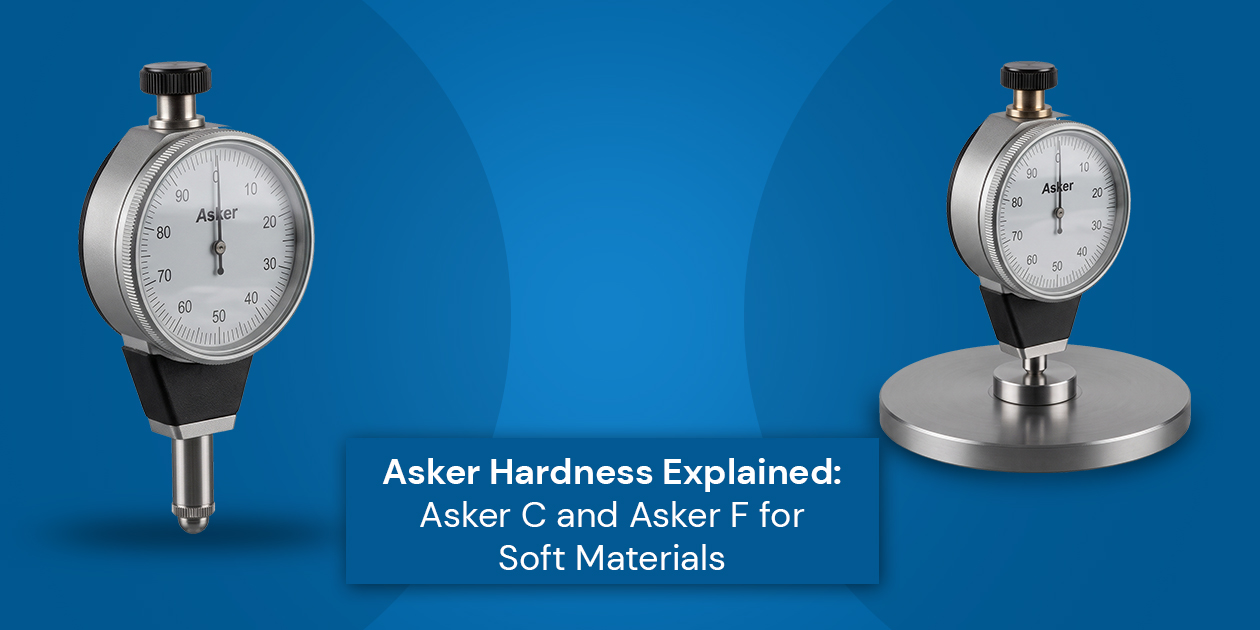
Asker hardness measures how well a soft material resists a spring-loaded indenter. The Asker hardness scale runs from 0 to 100, and a higher number means a harder material. Asker C covers soft rubber, foam, and sponge. Asker F covers much softer, low-hardness materials.
This guide explains the Asker hardness scale, compares Asker C and Asker F, and shows how to handle an Asker C hardness conversion to Shore A. It also covers real-world uses and how to choose a tester. We have built hardness testers since 1954, and our durometers cover Asker C, Asker CS, and Asker F alongside the Shore scales.
Key takeaways:
- Asker C: the standard scale for soft rubber, foam, and sponge
- Asker F: a softer-range scale with a larger, flat cylindrical indenter
- Asker CS: a related scale with a flat cylindrical indenter and a heavier spring, used for polystyrene foam
- Conversion: no exact formula links Asker C to Shore A, so measure with the scale your specification names
- Not the same as Shore C: Asker C and Shore C are different scales
What Is Asker Hardness?
Asker hardness is an indentation hardness value from an Asker durometer. You press the durometer onto a sample until the presser foot sits flat. The spring pushes an indenter into the material, and the depth of penetration becomes a number from 0 to 100.
The Asker range includes several types, such as C, CS, and F. Each type has its own indenter and spring. Asker C is the best known. Both “Asker C 25” and “C25” are commonly used.
Asker C follows Japanese standards, including JIS K 7312, JIS S 6050, and SRIS 0101, a standard from the Society of Rubber Industry, Japan. ASTM D2240 and ISO 48-4 cover the Shore scales instead. Our analog durometers list SRIS 0101 and JIS K 6253 next to ASTM D2240, ISO 48-4, and ISO 868 for this reason.
Asker Hardness Scale: How the Types Compare
| Type | Indenter | Spring force (0 to 100) | Typical materials |
| Asker C | 5.08 mm hemisphere | 55 to 855 gf | Soft rubber, pressure rollers, leather, footwear midsoles |
| Asker CS | Flat cylinder, smaller than Asker F | Heavier spring than Asker C | Polystyrene foam |
| Asker F | 25.2 mm flat cylinder | 55 to 455 gf | Soft foam and sponge |
gf = gram-force. The Asker C values follow SRIS 0101.
Two design choices explain most of the differences. The indenter shape sets how the tip meets the material. The spring range sets how much force the tip applies. Lighter springs and wider tips suit softer materials.
Asker C Hardness Scale: Range and What the Numbers Mean
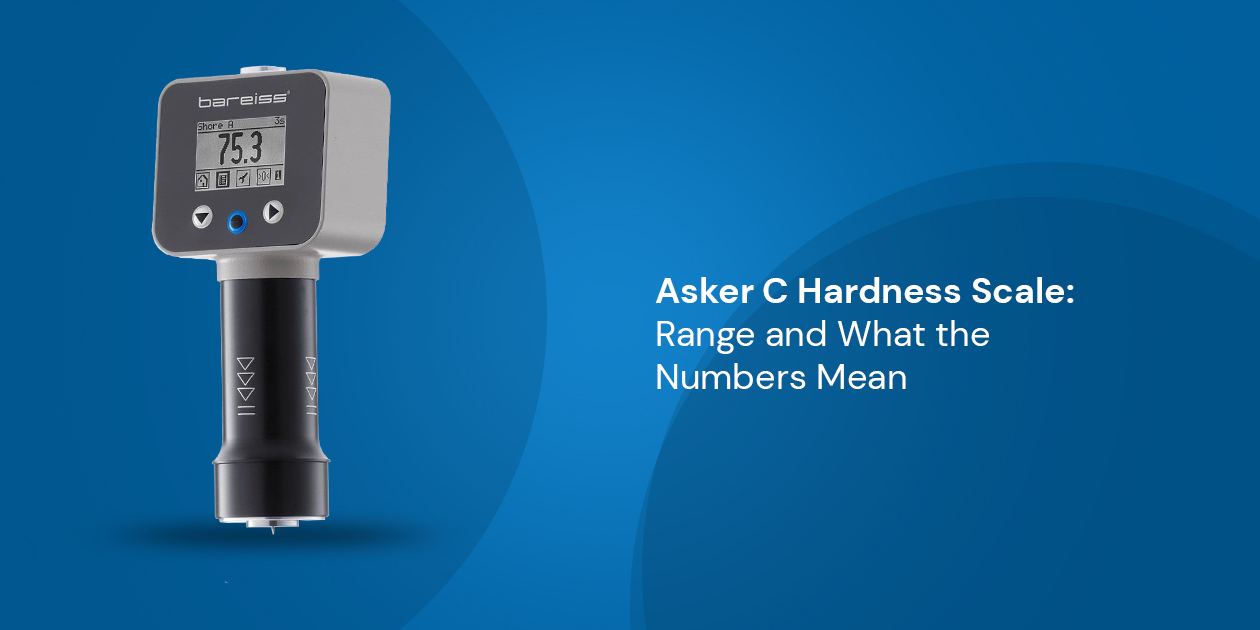
The Asker C hardness scale reads from 0 to 100. Under SRIS 0101, the spring applies 55 gf at zero and 855 gf at 100. Published work shows where real materials land. The PLOS ONE study below used running-shoe midsoles from C40 to C65.
Asker C Hardness Conversion to Shore A
No exact Asker C hardness conversion to Shore A exists. The two scales use different indenters, springs, and presser feet, so one number does not map to the other. Foam density, skin thickness, and cell structure also change how each tip responds. A converted number should never replace a measured one.
Our advice is simple:
- Measure on the scale your customer names. If the drawing says Asker C 45, test with an Asker C durometer.
- Report the scale with the number. “45” alone is ambiguous, but “Asker C 45” is not.
- Check the Shore letter. Shore C belongs to ASTM D2240 and suits harder materials. Asker C follows SRIS 0101. They are different scales.
If you need to relate foam readings to a Shore A specification, our team can help you plan a side-by-side test on your own samples.
Asker C vs. Asker F Hardness
Asker C and Asker F both measure soft materials, but they sit in different parts of the softness range.
| Feature | Asker C | Asker F |
| Indenter | 5.08 mm hemisphere | 25.2 mm flat cylinder |
| Top spring force | 855 gf | 455 gf |
| Best for | Soft rubber, pressure rollers, leather | Much softer foam and sponge specimens |
Asker C uses a small rounded tip, so it presses into a small area. Asker F uses a wide flat cylinder, so it spreads its load over a larger area.
A practical rule follows. Start with Asker C for soft rubber. If your sample is a very soft foam or sponge and Asker C struggles, move to Asker F.
Uses of Asker C and Asker F Hardness
Manufacturers rely on Asker hardness wherever a material is too soft for Shore A:
- Footwear: running-shoe midsoles are specified and studied by Asker C.
- Soft rubber and elastomers: Asker C suits natural rubber products, neoprene, cast resin, soft PVC, and leather.
- Rubber rollers: roller makers test pressure-roller coverings with Asker C.
- Foam and sponge: producers check cellular rubber and soft foam with Asker C or Asker F.
- Polystyrene foam: Asker CS is the scale used for this material.
Our foam testing solutions serve these markets. For foams that also need a resilience check, our rebound resilience tester adds a second data point.
Case Study: What Asker C Reveals in Running Shoes
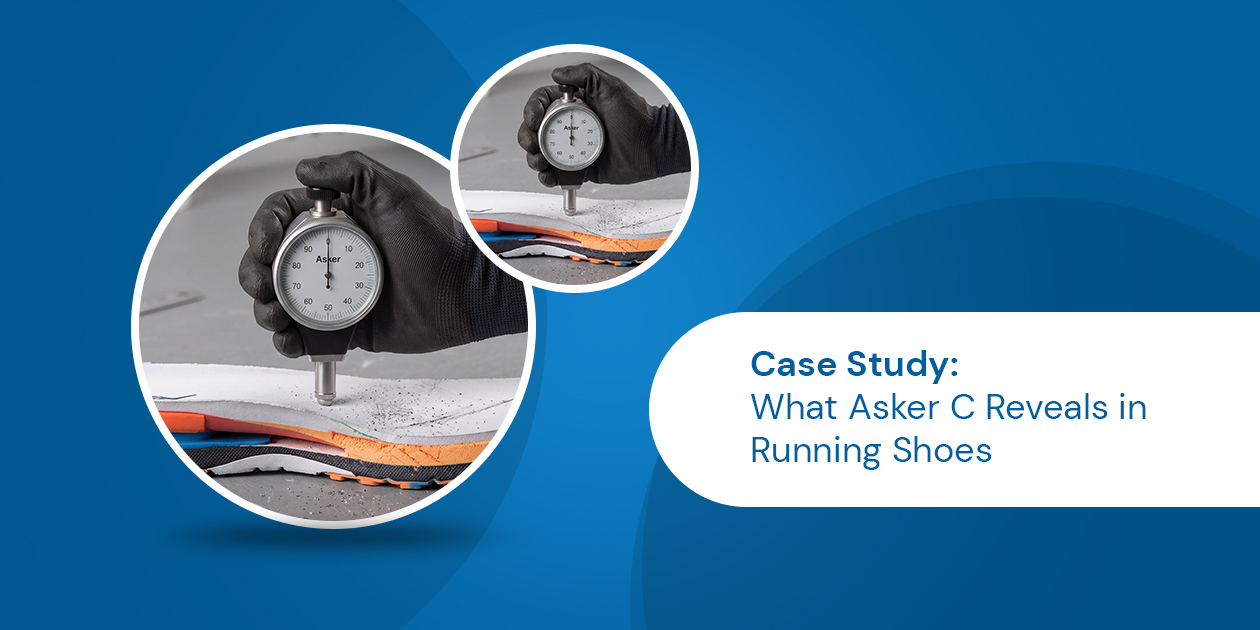
Researchers use Asker C to define midsole hardness in biomechanics studies. One large study shows why the numbers matter.
Baltich, Maurer, and Nigg (PLOS ONE, 2015). The team tested 93 runners aged 16 to 75 in three shoes that differed only in midsole hardness: Asker C 40 (soft), C 52 (medium), and C 65 (hard). The vertical impact peak rose as the midsole got softer. It averaged 1.70 body weights in the soft shoe, 1.64 in the medium shoe, and 1.54 in the hard shoe. The full paper is open access.
What this means for quality control:
- A 25-point spread on the Asker C scale (C40 to C65) changed measured impact forces. Spec tolerances need care.
- Two labs can only compare results if both name the scale, the instrument, and the method.
- A shoe brand that sets midsole hardness by Asker C needs a tester it can trust and trace.
Asker C Hardness Tester: How to Choose and Use One?
An Asker C hardness tester is a spring-loaded durometer with a 5.08 mm hemispherical indenter. Our analog durometers list Asker C, Asker CS, and Asker F among their measuring methods. Our digital durometers list the same three, offer an optional ambient temperature and humidity sensor, and export data over RS232/USB. Specifications and scales are listed on each product page.
Asker CS uses a flat cylindrical indenter and a heavier spring than Asker C. It is the scale for polystyrene foam, so choose it when your specification names it.
Use these questions to pick a tester:
- Which scale does your specification name? Choose C, CS, or F to match it.
- How big is the sample? Our HP durometer procedure for rubber and plastics calls for a smooth, flat specimen of at least 35 mm diameter and 6 mm thickness. For foam, follow the standard your customer cites.
- Do you need operator-independent results? Our test stands hold the durometer at a precise 90° angle. The automatic BSA stand also lowers it at the speed the standard requires.
- Do you need traceable results? We supply ISO/IEC 17025 accredited calibration certificates for different measuring devices through our calibration laboratory.
Follow these steps when you test:
- Hold the durometer vertically and press until the presser foot sits fully on the sample.
- Take the reading after 3 seconds. For non-homogeneous material, extend the time to 15 seconds.
- Keep the instrument steady and parallel to the specimen. A tilted foot gives unreliable results.
- Record room temperature and contact pressure with the result.
If you prefer to test before you buy, our sample testing service can measure your samples for you.
Why Trust Our Guidance on Asker Hardness?
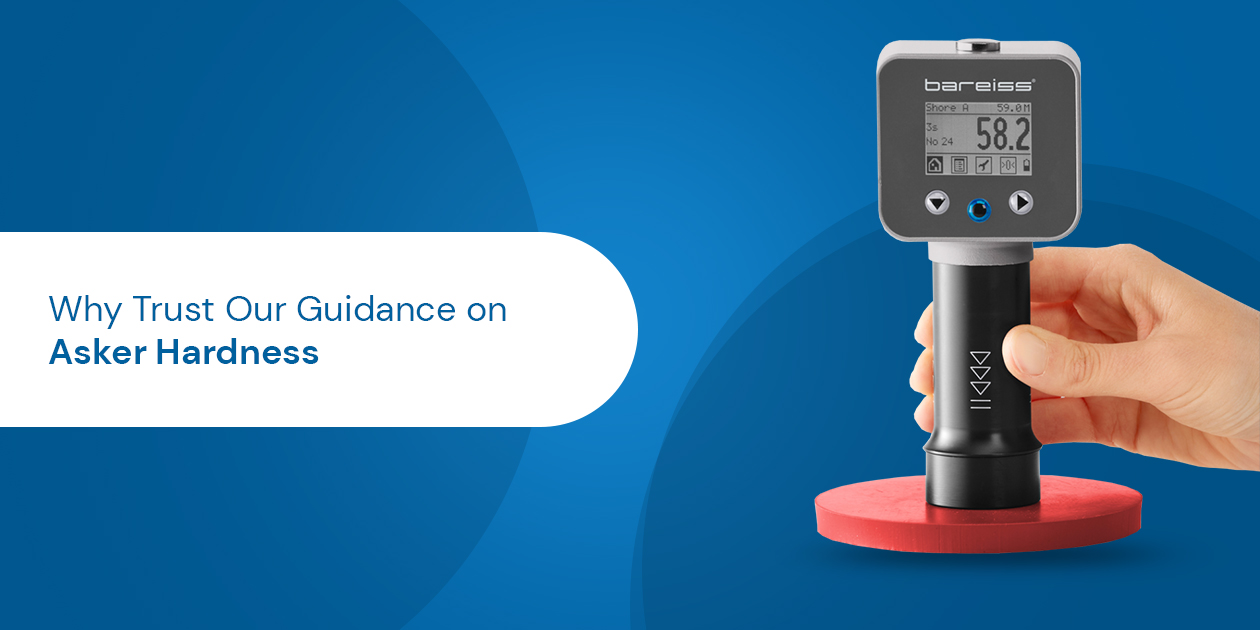
- Experience: we have offered testing solutions since 1954.
- Calibration: In 1996, we became the first DKD calibration laboratory in Germany, and today we calibrate to ISO/IEC 17025 as a DAkkS-accredited laboratory.
- Local support: Bareiss North America provides local sales, technical support, calibration, and after-sales service across the United States, Canada, and Mexico from Stouffville, Ontario.
Frequently Asked Questions
Asker hardness is an indentation hardness value from an Asker durometer, read on a 0 to 100 scale. A higher number means a harder material. Asker types such as C, CS, and F cover soft rubber, foam, sponge, and similar materials.
The Asker C hardness scale rates soft rubber and foam from 0 to 100. It uses a 5.08 mm hemispherical indenter and a spring that applies 55 to 855 gf. The midsoles in one published running study ranged from C40 to C65.
Manufacturers use Asker C to test and specify soft materials. Common uses include footwear midsoles, soft rubber and elastomers, leather, and pressure rollers.
Asker C uses a small rounded tip and a spring up to 855 gf. Asker F uses a 25.2 mm flat cylinder and a spring up to 455 gf. Asker F suits much softer foam and sponge specimens.
You cannot convert it exactly. The scales use different indenters and springs, and foam structure changes the result. Measure with the scale your specification names, and contact us if you need a side-by-side test on your own samples.
No. Shore C belongs to ASTM D2240 and suits harder materials. Asker C is a separate Japanese scale for soft rubber and foam.
Asker C is covered by Japanese standards, including JIS K 7312 and JIS S 6050, and many sources cite SRIS 0101. ASTM D2240 and ISO 48-4 cover the Shore scales, not Asker.
Accuracy depends on the instrument, its calibration, and your technique. Keep the presser flat and parallel to the sample, because a tilted foot gives unreliable results, and calibrate regularly.
We offer ISO/IEC 17025 accredited calibration certificates for different measuring devices. Contact us with your model and scale, and we will confirm what we can calibrate.