What Are the 10 Levels of Hardness? A Complete Guide to the Mohs Hardness Scale
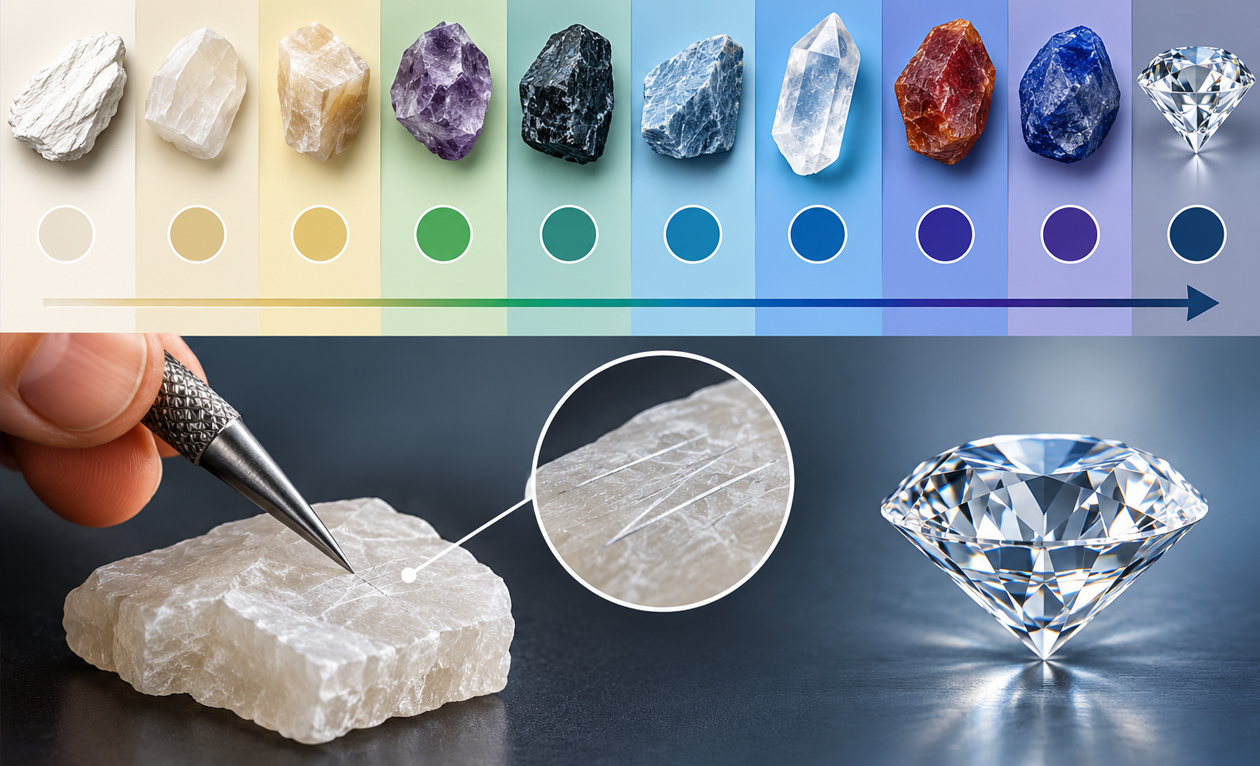
What “10 Levels of Hardness” Actually Means
When people ask “what are the 10 levels of hardness,” they’re almost always referring to the Mohs hardness scale, a ranking system developed by German mineralogist Friedrich Mohs in 1812 to classify minerals by their resistance to scratching. It remains the most widely recognized hardness scale in geology, gemology, and materials education, even though modern industrial testing has largely moved to more precise, instrument-based methods like Shore durometers and Rockwell testers.
The Mohs scale works on a simple principle: a mineral higher on the scale can scratch a mineral lower on the scale, but not the other way around. It’s a relative, ordinal scale rather than a proportional one; the jump from level 9 to level 10 represents a far bigger real-world hardness difference than the jump from level 1 to level 2.
This guide walks through each of the 10 levels, explains how the scale is used in practice, and compares it to the hardness scales used in industrial quality control, such as Shore A/D and Rockwell testing.
The 10 Levels of the Mohs Hardness Scale
Level 1: Talc
The softest mineral on the scale, talc can be scratched with a fingernail and has a greasy, soapy feel. It’s the base ingredient in talcum powder and is used industrially as a filler in paints, plastics, and ceramics.
Level 2: Gypsum
Slightly harder than talc but still scratchable with a fingernail, gypsum is common in drywall (as the mineral behind plaster of Paris) and forms the basis of many construction materials.
Level 3: Calcite
Calcite can be scratched with a copper coin but not a fingernail. It’s the primary component of limestone and marble, and reacts visibly with dilute acid a classic field test geologists use to identify it.
Level 4: Fluorite
Fluorite requires a steel knife to scratch and is prized for its wide range of vivid colors. It’s used industrially in the production of hydrofluoric acid and as a flux in steel manufacturing.
Level 5: Apatite
Apatite is just barely scratched by a steel knife blade. It’s notable as the mineral group that makes up the mineral content of tooth enamel and bone.
Level 6: Feldspar (Orthoclase)
Feldspar resists a steel knife but can be scratched by a piece of quartz or a steel file. As the most abundant mineral group in Earth’s crust, feldspar is a key ingredient in ceramics and glassmaking.
Level 7: Quartz
Quartz cannot be scratched by steel and instead scratches glass. It’s one of the most common minerals on Earth’s surface and is widely used in electronics, glassmaking, and as a gemstone (amethyst and citrine are both quartz varieties).
Level 8: Topaz
Topaz easily scratches quartz and glass. Valued as a gemstone in its clear, blue, and golden varieties, topaz also sees industrial use as an abrasive.
Level 9: Corundum
Corundum is the second-hardest natural mineral, scratching nearly everything except diamond. Its gem varieties ruby (red) and sapphire (any other color) are prized in jewelry, while industrial-grade corundum is a widely used abrasive in sandpaper and grinding wheels.
Level 10: Diamond
The hardest known natural material, diamond can scratch every other substance on the scale and can only be scratched by another diamond. Beyond jewelry, diamond’s hardness makes it essential for industrial cutting tools, drill bits, and precision grinding applications.
How the Mohs Scale Is Actually Tested
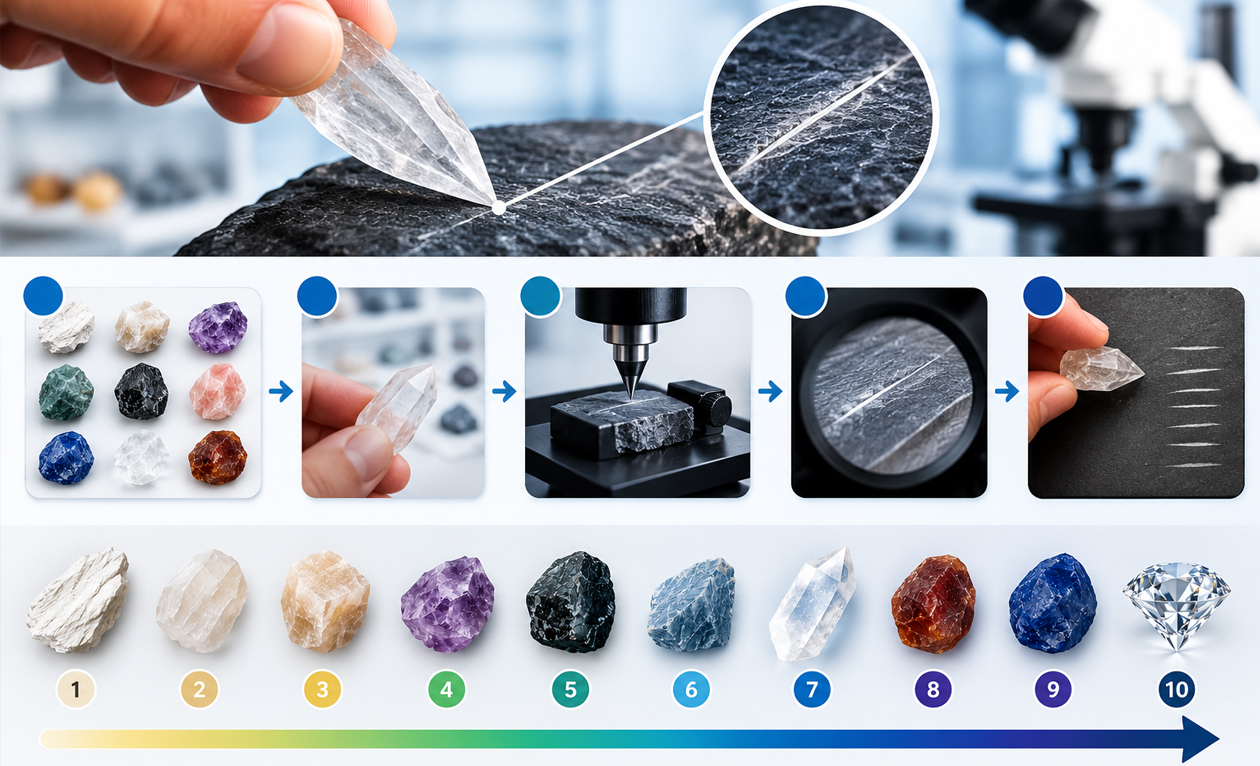
Mohs hardness testing is refreshingly low-tech: a tester attempts to scratch a mineral’s surface using reference materials or picks of known hardness, working up or down the scale until they find the point where scratching stops. Field geologists often use household proxies as quick reference points:
- Fingernail: approximately 2.5.
- Copper coin: approximately 3.5.
- Steel knife blade: approximately 5.5.
- Glass: approximately 5.5.
- Steel file: approximately 6.5.
Because the Mohs scale only tells you the order of hardness, not the magnitude of difference, it’s excellent for quick mineral identification in the field but far too imprecise for industrial quality control, where manufacturers need repeatable, quantifiable data.
How the Mohs Scale Compares to Industrial Hardness Testing
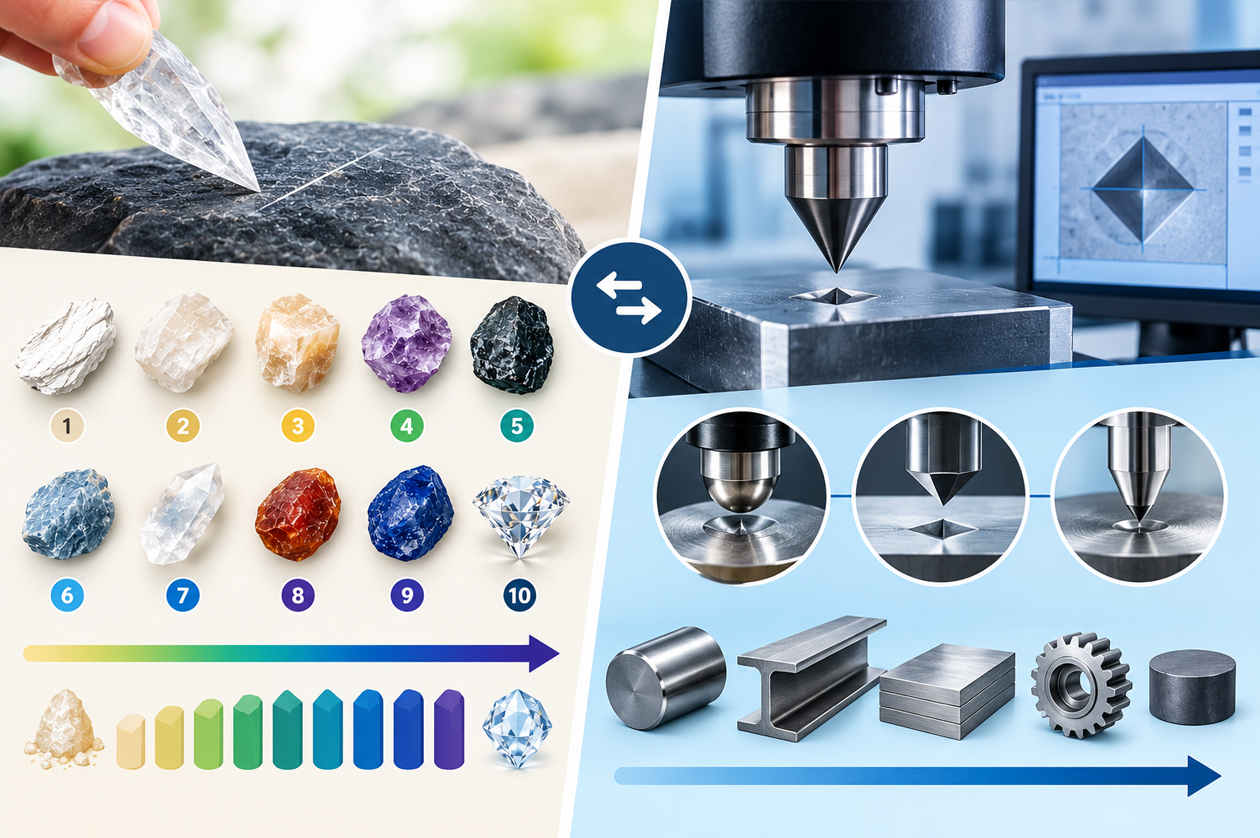
Manufacturing and quality control environments rely on hardness scales that produce precise, repeatable numerical readings rather than a simple scratch-based ranking. The most common industrial alternatives include:
- Shore A and Shore D durometer testing: Used for rubber, elastomers, and plastics, measuring resistance to indentation rather than scratching. Governed by ASTM D2240 and ISO 868.
- Rockwell, Brinell, and Vickers testing: Used primarily for metals, these methods press a calibrated indenter into the material and measure the resulting indentation depth or size.
Unlike Mohs hardness, which is ordinal (level 10 isn’t “twice as hard” as level 5), these industrial scales produce proportional, quantifiable data that can be tracked, compared across batches, and tied to specific material specifications. For quality teams working with rubber, plastic, or metal components, instruments such as the Bareiss HPE III digital durometer or the fully automated Bareiss digi test II provide the kind of precise, repeatable hardness data that a scratch test simply can’t deliver.
Why the Mohs Scale Still Matters
Despite its age and simplicity, the Mohs scale remains genuinely useful in several contexts:
- Gemology and jewelry: Determining whether a gemstone is durable enough for daily wear (rings, for instance, benefit from stones at 7 or higher to resist scratching from everyday quartz dust).
- Geology fieldwork: Quick mineral identification without lab equipment.
- Education: Introducing the concept of relative hardness before moving into more technical, instrument-based testing methods like Shore or Rockwell scales.
- Material selection: Engineers sometimes reference Mohs hardness informally when comparing wear resistance of natural materials like stone countertops or ceramic tile.
Frequently Asked Questions
From softest to hardest: talc (1), gypsum (2), calcite (3), fluorite (4), apatite (5), feldspar/orthoclase (6), quartz (7), topaz (8), corundum (9), and diamond (10).
Rarely for formal quality control. Industrial settings typically use Shore, Rockwell, Brinell, or Vickers hardness testing, since these produce precise, repeatable numerical data rather than a simple relative ranking. The Mohs scale is more common in geology, gemology, and educational contexts.
A fingernail has a Mohs hardness of roughly 2.5, close to gypsum (2). This is why gypsum and talc can both be scratched with a fingernail, while calcite (3) requires something slightly harder, like a copper coin.
The Mohs scale only ranks minerals in order of which can scratch which doesn’t measure the actual force or energy required. In absolute terms, the hardness gap between corundum (9) and diamond (10) is far larger than the gap between talc (1) and gypsum (2), even though both represent a single step on the scale.
Mohs hardness measures resistance to scratching and is used for minerals and gemstones. Shore hardness measures resistance to indentation under a calibrated spring force and is used for rubber, elastomers, and plastics. The two scales aren’t directly convertible, since they measure fundamentally different mechanical responses.