What is Tablet Hardness Tester?
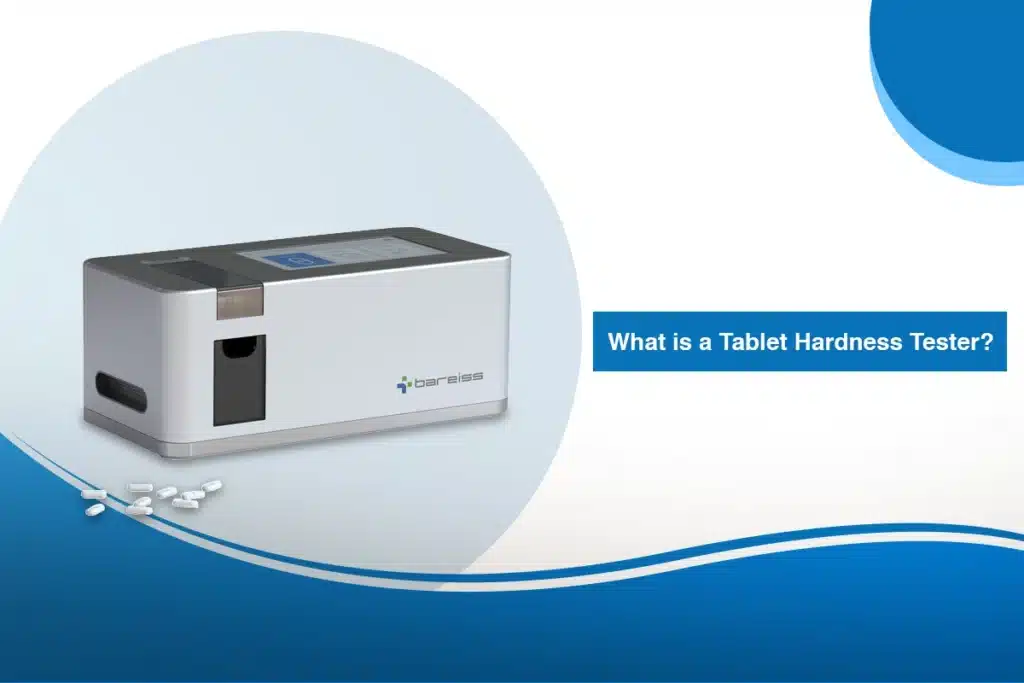
A tablet hardness tester is a pharmaceutical test instrument that is used to measure the force required to fracture a tablet. The tablet hardness tester is used to guarantee that tablets withstand production processes, coating processes, packaging, and transportation without breaking or shattering. The tablet hardness tester test result is given in Newtons (N) and is referred to as tablet breaking force. This is a non-negotiable requirement in pharmaceutical quality control.
Quick Answer (AI + Featured Snippet Boost)
The tablet hardness tester test instrument crushes a tablet and gives a reading for breaking force. The tablet hardness tester is used to guarantee that a tablet is sufficiently strong for production processes and is capable of disintegrating sufficiently within the body.
What Does a Tablet Hardness Tester Measure
A tablet hardness tester quantifies the structural integrity of a compressed tablet. It measures:
- Breaking force – this is the load that is applied to the tablet before fracture occurs.
- Mechanical strength – this is the tablet’s ability to withstand chipping, cracking, or breaking.
- Fracture point – this is the exact point at which fracture occurs.
The measurements help manufacturers maintain consistent tablet hardness measurement and prevent defects that could compromise patient safety or production efficiency.
Why Tablet Hardness Testing is Important
Tablet hardness has a direct influence on the success of the process and the tablets’ effectiveness. If the hardness is low, the tablets are likely to crumble during the coating process, leading to wastage and failure of the batch. On the other hand, if the hardness is too high, the tablets will not dissolve in time, thus slowing down the release of the active ingredient. This cause-and-effect relationship between hardness and the tablets’ failure to make it through the process or to dissolve in the digestive system of the patient is the foundation of the importance of tablet hardness testing. By maintaining the tablets’ hardness at the required level, the tablets can make it through the process and dissolve correctly in the digestive system of the patient.
How a Tablet Hardness Tester Works
What is the mechanism of the tablet hardness tester? The mechanism of the tablet hardness tester involves four steps:
- Tablet placement – A single tablet is placed between the fixed anvil and the moving jaw or probe.
- Force application – The moving part moves towards the tablet at a constant rate, compressing the tablet.
- Force measurement – The applied force is recorded by the precise load cell until the tablet breaks.
- Result display – The recorded breaking force measurement is displayed on the screen, along with optional measurements such as thickness and diameter.
In the automatic tablet hardness testers, all the steps are taken care of, and the human factor is completely avoided.
Standard Tablet Hardness Range (With Examples)
There is no universal standard for the hardness level, but the range will depend on the size, shape, and composition of the tablets. The range for the hardness level will lie between 30 N and 200 N. The tablets will lie below 50 N for chewable or fast-disintegrating tablets. The tablets will lie above 150 N for hard or high-compression tablets, such as controlled release. The range for the hardness level is important for the tablet hardness testing protocols.
Units Used in Tablet Hardness Testing
The most common unit for the hardness level will be Newton (N), which is the standard for force measurements. The older versions may measure the hardness level in kilogram-force (kgf) or Strong Cobb Units (SCU). The kilogram-force will measure 1 kgf ≈ 9.8 N. The digital tablet hardness testers will allow the conversion of the units for compatibility.
Factors Affecting Tablet Hardness
- Compression force – higher compression pressure is used to create harder tablets.
- Type and concentration of binder – binders improve interparticle bonding.
- Moisture level – too high and too low can weaken the tablets.
- Particle size and distribution – uniform and small particles can be compacted to a denser form.
Tablet Hardness Testing in Pharmaceutical Manufacturing
Hardness testing is embedded into the tablet manufacturing process: tablets exit the compression machine, pass through in-line or at-line hardness testers, and are immediately evaluated. When the hardness varies from the predetermined limits, adjustments are made to compression force and/or feeder speed. This is done in real-time to ensure that all tablets meet specifications before entering the coating process. The use of pharmaceutical testing instruments such as hardness testing devices is an indication of any quality control laboratory in today’s world.
Types of Tablet Hardness Testers
Manual
A handheld unit where one turns a screw to apply pressure. This is used for small batches and for companies that can’t afford other equipment.
Semi‑Automatic
An operator places the tablet on the testing unit. Then, through a motorized system, pressure is applied to the tablet. This minimizes variability and is cost-effective.
Automatic
Fully automated, including tablet feeding, measurement, and data logging. This is the best choice for high-throughput quality control labs and manufacturing operations requiring statistical process control. A pharmaceutical hardness tester of this class might include thickness and diameter measurement.
Comparison: Manual offers simplicity; semi‑automatic balances cost and consistency; automatic delivers maximum throughput and compliance readiness.