Introduction
In pharmaceutical manufacturing, the quality of a tablet is not just about its active ingredient it is equally about its physical properties. One of the most critical physical attributes that determines whether a tablet will survive handling, packaging, transportation, and ultimately dissolve correctly in the body is its hardness.
But what exactly is tablet hardness, and more importantly, how do you calculate the hardness of a tablet? Whether you are a pharmaceutical scientist, a quality control technician, or a student stepping into the world of tablet formulation, understanding how to measure and calculate tablet hardness is a foundational skill.
In this comprehensive guide, we will walk you through everything you need to know — from the basic concept of tablet hardness to the step-by-step process of calculating it, the units involved, the equipment used, and the standards you need to meet. For background on the broader process that leads up to this stage, see our guide on the tablet compression process and its impact on hardness.
What Is Tablet Hardness?
Tablet hardness refers to the mechanical strength of a tablet specifically, its ability to resist breaking, chipping, or crumbling under applied force. It is essentially a measure of the crushing strength of a tablet when pressure is applied diametrically (across its diameter).
In simple terms, tablet hardness is the force required to break a tablet in half.
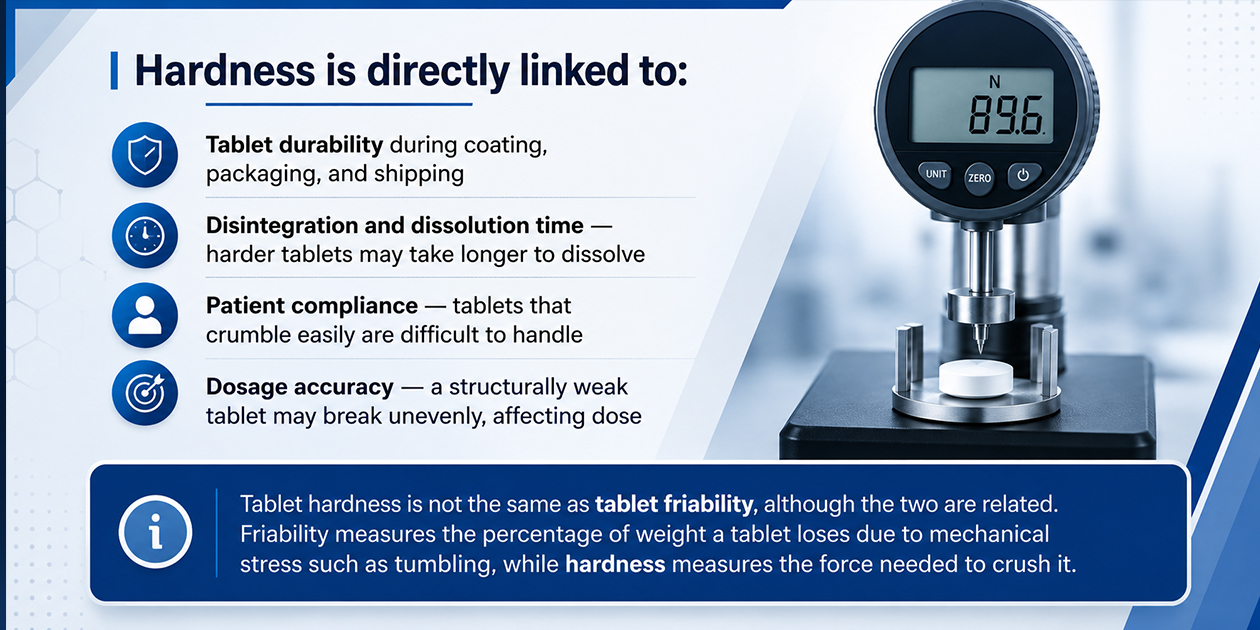
Hardness is directly linked to:
- Tablet durability during coating, packaging, and shipping
- Disintegration and dissolution time — harder tablets may take longer to dissolve
- Patient compliance — tablets that crumble easily are difficult to handle
- Dosage accuracy — a structurally weak tablet may break unevenly, affecting dose
Tablet hardness is not the same as tablet friability, although the two are related. Friability measures the percentage of weight a tablet loses due to mechanical stress such as tumbling, while hardness measures the force needed to crush it.
Why Is Calculating Tablet Hardness Important?
Tablet hardness testing is a mandatory part of pharmaceutical quality control. Regulatory bodies such as the USP (United States Pharmacopeia), BP (British Pharmacopoeia), and IP (Indian Pharmacopoeia) require manufacturers to test and document tablet hardness as part of their quality assurance protocols.
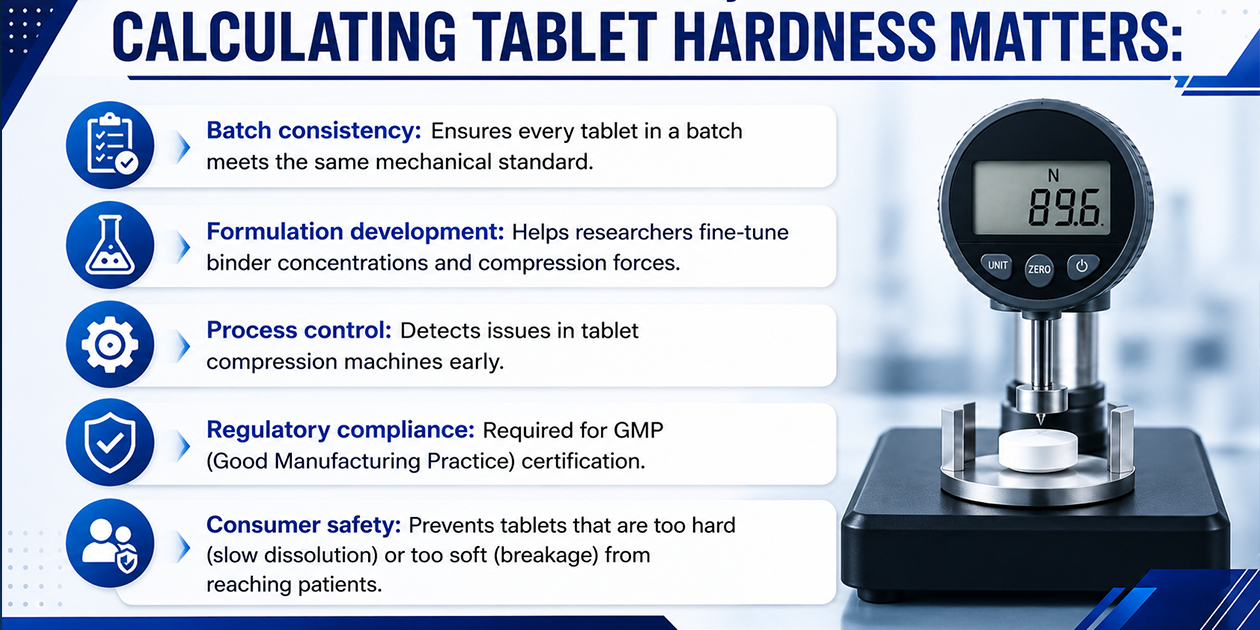
Here is why calculating tablet hardness matters:
- Batch consistency: Ensures every tablet in a batch meets the same mechanical standard.
- Formulation development: Helps researchers fine-tune binder concentrations and compression forces.
- Process control: Detects issues in tablet compression machines early.
- Regulatory compliance: Required for GMP (Good Manufacturing Practice) certification.
- Consumer safety: Prevents tablets that are too hard (slow dissolution) or too soft (breakage) from reaching patients.
3. Units Used in Tablet Hardness Testing
Before diving into the calculation, it is important to understand the units used in tablet hardness testing, as results can be expressed in multiple ways depending on the instrument and the region. For a complete breakdown, see our dedicated guide on units used in tablet hardness testing.
3.1 Newtons (N)
The Newton is the SI unit of force and the most widely accepted unit in modern pharmaceutical tablet hardness testing, as defined by the International System of Units (SI). Most current hardness testers report results in Newtons.
3.2 Kiloponds (kp)
A kilopond (also called kilopond-force or kgf) is an older unit still used in some parts of the world. One kilopond equals the force of gravity on a mass of one kilogram.
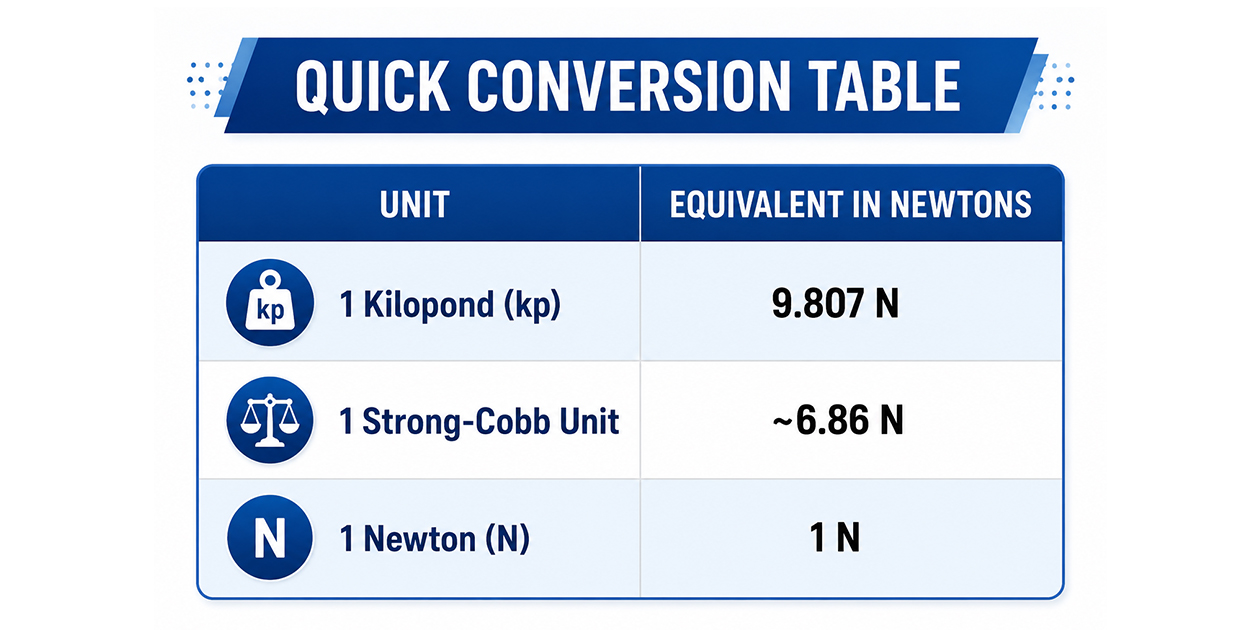
Conversion: 1 kp = 9.807 N ≈ 9.81 N
3.3 Strong-Cobb Units (SCU)
Strong-Cobb Units are an older proprietary unit developed for early hardness testers. They are rarely used today but may still appear in legacy documentation.
Conversion: 1 SCU ≈ 0.7 kp ≈ 6.86 N
Quick Conversion Table
| Unit |
Equivalent in Newtons |
| 1 Kilopond (kp) |
9.807 N |
| 1 Strong-Cobb Unit |
~6.86 N |
| 1 Newton (N) |
1 N |
4. Standard Tablet Hardness Range
Understanding the standard tablet hardness range is essential before you begin calculating and interpreting results. There is no single universal hardness value that applies to all tablets — the acceptable range depends on the tablet type, size, coating, and intended use. For a deeper look at this topic, see our full guide on the standard tablet hardness range.
However, general industry guidelines suggest:
| Tablet Type |
Hardness Range |
| Uncoated tablets |
4 – 10 kp (39 – 98 N) |
| Film-coated tablets |
8 – 12 kp (78 – 118 N) |
| Effervescent tablets |
12 – 18 kp (118 – 177 N) |
| Chewable tablets |
3 – 6 kp (29 – 59 N) |
| Sustained-release tablets |
10 – 20 kp (98 – 196 N) |
Most standard uncoated tablets fall in the range of 4 kp to 10 kp (approximately 39 N to 98 N). Tablets below 4 kp are generally considered too soft and prone to breakage, while tablets exceeding the upper limit may have dissolution problems.
Equipment Used: The Tablet Hardness Tester
To calculate tablet hardness, you need a tablet hardness tester (also called a tablet crushing strength tester or tablet hardness meter). Learn more about what a tablet hardness tester is and how it functions. There are two main types:
Manual Hardness Testers
Older devices such as the Monsanto tester and Pfizer tester require manual operation. The operator places the tablet and applies force manually until the tablet breaks, then reads the result from a dial or scale.
- Monsanto Tester: The tablet is placed vertically between a stationary anvil and a moveable piston. A spring is compressed by turning a screw until the tablet fractures.
- Pfizer Tester: Works like a pair of pliers — the tablet is placed between two jaws and pressure is manually applied. Results are read on a gauge.
Automatic Hardness Testers
Modern automatic tablet hardness testers, such as the THT500 Tablet Hardness Tester, are motorized instruments that apply force at a controlled, constant rate and automatically record the breaking force digitally. They offer higher accuracy, reproducibility, and can test multiple tablets in sequence.
Key features of modern testers include:
- Digital display in N, kp, or SCU
- Automatic jaw speed control
- Data logging and statistical analysis (mean, SD, RSD)
- Compliance with USP, BP, and Ph. Eur. requirements
How to Calculate Hardness of Tablet: Step-by-Step
Now let’s get to the core question: how to calculate the hardness of a tablet.
Step 1 — Prepare Your Samples
Select tablets randomly from the batch. According to USP guidelines, a minimum of 10 tablets should be tested per batch to get a statistically reliable result.
- Tablets should be free from visible defects
- Store samples at controlled temperature and humidity before testing
- Do not use broken or chipped tablets
Step 2 — Set Up the Hardness Tester
- Calibrate the hardness tester before use using certified reference weights or calibration tools
- Ensure the jaws or anvils are clean and properly aligned
- Set the unit of measurement (N or kp) as required by your SOP
Step 3 — Position the Tablet
- Place the tablet diametrically between the two jaws of the tester — meaning the force should be applied across the tablet’s diameter, not on its flat face
- For round tablets, position them horizontally
- For oblong or oval tablets, position them lengthwise (along the major axis) unless otherwise specified
Step 4 — Apply Force and Record the Breaking Point
- Start the test — the instrument applies a gradually increasing, controlled force
- The tester automatically detects the point at which the tablet fractures (the breaking force)
- Record the force value displayed at the moment of fracture
Step 5 — Apply the Tablet Hardness Formula
The hardness of a tablet is expressed as the crushing strength — the force applied at the point of fracture.
Tablet Hardness Formula:
Hardness (H) = Force applied at fracture point (F)
Since hardness testers directly measure and display the fracture force, no additional mathematical formula is required for basic hardness. The instrument reading IS the hardness value.
However, when calculating mean hardness across multiple tablets:
Mean Hardness = Sum of all individual hardness values / Number of tablets tested
Example:
Ten tablets were tested and gave the following hardness values (in N):
52, 55, 58, 54, 56, 53, 57, 55, 54, 56
Mean Hardness = (52+55+58+54+56+53+57+55+54+56) / 10 = 550 / 10 = 55 N
Step 6 — Calculate Standard Deviation (SD) and RSD
For full quality control reporting, you should also calculate:
Standard Deviation (SD):
SD = √[Σ(xi − x̄)² / (n−1)]
Where:
- xi = individual hardness value
- x̄ = mean hardness
- n = number of tablets
Relative Standard Deviation (RSD) / Coefficient of Variation:
RSD (%) = (SD / Mean) × 100
A low RSD (typically below 5%) indicates good batch uniformity.
Step 7 — Unit Conversion (If Required)
If your tester reports in kp but your specification requires Newtons (or vice versa), use the following conversions:
- kp to N: Multiply by 9.807 → Example: 6 kp × 9.807 = 58.84 N
- N to kp: Divide by 9.807 → Example: 58.84 N ÷ 9.807 = 6 kp
- SCU to N: Multiply by 6.864 → Example: 8 SCU × 6.864 = 54.91 N
Factors That Affect Tablet Hardness
Understanding what influences tablet hardness helps in both formulation development and troubleshooting during tablet compression. Key factors include:
Compression Force
The most direct factor. Higher compression force during tableting generally produces harder tablets. However, excessive force can cause capping or lamination defects.
Binder Type and Concentration
Binders hold tablet particles together. Increasing binder concentration typically increases hardness, but too much can reduce disintegration.
Moisture Content
Higher moisture in granules generally leads to softer tablets. Moisture acts as a plasticizer and can reduce inter-particle bonding after compression.
Particle Size Distribution
Finer particles generally pack more tightly, resulting in harder tablets. Coarser particles may produce softer, more porous tablets.
Punch and Die Condition
Worn or damaged punches produce tablets with inconsistent hardness. Regular maintenance of compression tooling is essential.
Dwell Time
The time the tablet spends under maximum compression force. Longer dwell time generally increases hardness by allowing better bonding between particles.
Relationship Between Hardness and Other Tablet Properties
Tablet hardness does not exist in isolation it has a direct relationship with several other critical tablet quality parameters:
Hardness vs. Friability
As hardness increases, friability generally decreases. A tablet that is too soft will have high friability (weight loss >1% is typically unacceptable per USP). Optimizing hardness is therefore key to passing friability tests.
Hardness vs. Disintegration Time
Harder tablets typically take longer to disintegrate. If hardness is too high, disintegration time may exceed pharmacopoeial limits, affecting drug release and bioavailability.
Hardness vs. Dissolution
In extended-release or matrix tablets, hardness is deliberately higher to control dissolution rate. For immediate-release tablets, excessive hardness can slow dissolution below acceptable limits.
Common Mistakes in Tablet Hardness Testing
Even experienced QC teams can make errors that compromise results. Watch out for these common pitfalls:
- Not calibrating the instrument: Always calibrate before each testing session
- Testing too few tablets: A minimum of 10 tablets is recommended for reliable statistics
- Incorrect tablet orientation: Always apply force diametrically, not axially
- Ignoring environmental conditions: Temperature and humidity can affect results, especially for hygroscopic formulations
- Not recording time of testing: Hardness can change over time due to moisture absorption or loss
Regulatory Guidelines for Tablet Hardness
While no single pharmacopoeia specifies a universal hardness limit, the following guidance applies:
- USP General Chapter <1217> covers tablet breaking force and provides guidance on equipment and methodology
- Eur. 2.9.8 covers the resistance to crushing of tablets
- BP references similar standards aligned with Ph. Eur.
Most manufacturers define their own hardness specifications during product development, validated through clinical and stability studies.