What hardness should a pharmaceutical tablet have?
Pharmaceutical tablets do not have a constant hardness value as it is specifically defined by the formulation used and the intended function of the tablet. The range for typical compressed tablets is usually around 40 to 100 Newton (N), as this is a suitable strength to withstand normal conditions of packaging, transport, and handling. At the time of developing the formulation, the hardness is selected to provide optimum strength to meet the prescribed requirements for disintegration and drug release, so that a tablet meets the requirements of the appropriate pharmacopeia.
How does a tablet hardness tester work?
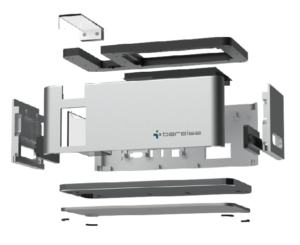
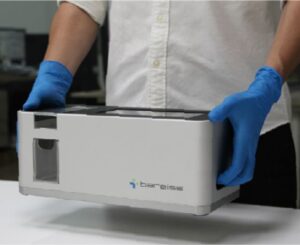
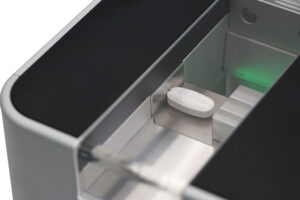
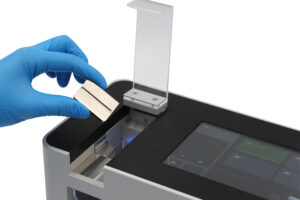
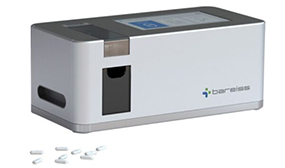
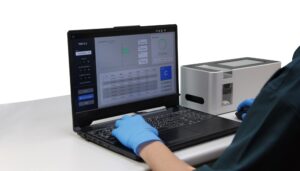
The THT500 tablet hardness tester has an upper and lower jaw, and as it applies force to the tablet at a constant rate through the upper jaw, it measures that force using a load cell. The load cell will then measure how much force is applied to the tablet until the tablet breaks; if the tablet breaks, that is the maximum breaking force, and therefore, it is the tablet’s hardness.
Here the tablet fracture detection occurs when load cell measures the tablet force measurementn throughout the test. The instrument records the maximum tablet fracture force that is applied to the tablet’s hardness value.
What unit measures tablet hardness?
The unit of measure used to describe tablet hardness or breaking force is the Newton (N), but some hardness testers may show results in Kiloponds (kp) or Kilogram-force (kgf). These two other units of measure hold some historical and/or regional significance but are not the preferred units of measure for measuring tablet hardness in the majority of modern pharmacopeias and when scientifically reporting the hardness of tablets in Newtons.
What affects tablet hardness during manufacturing?
The primary factor affecting tablet hardness is the compression force applied during tableting. Other important factors include:
- Powder or granulation properties (particle size, binder concentration, moisture content)
- Compression speed and dwell time
- Tablet size, thickness, and shape
- Lubricant level in the formulation
These variables influence how strongly the particles bond together during compression.
How many tablets should be tested for hardness?
The USP and the EP (European Pharmacopoeia) do not set forth a defined number of tablets that can be used for hardness-testing purposes because hardness testing is a process control test. Many laboratories routinely perform hardness testing on at least ten tablets to provide an accurate average for analysis and to ensure consistency between batches.