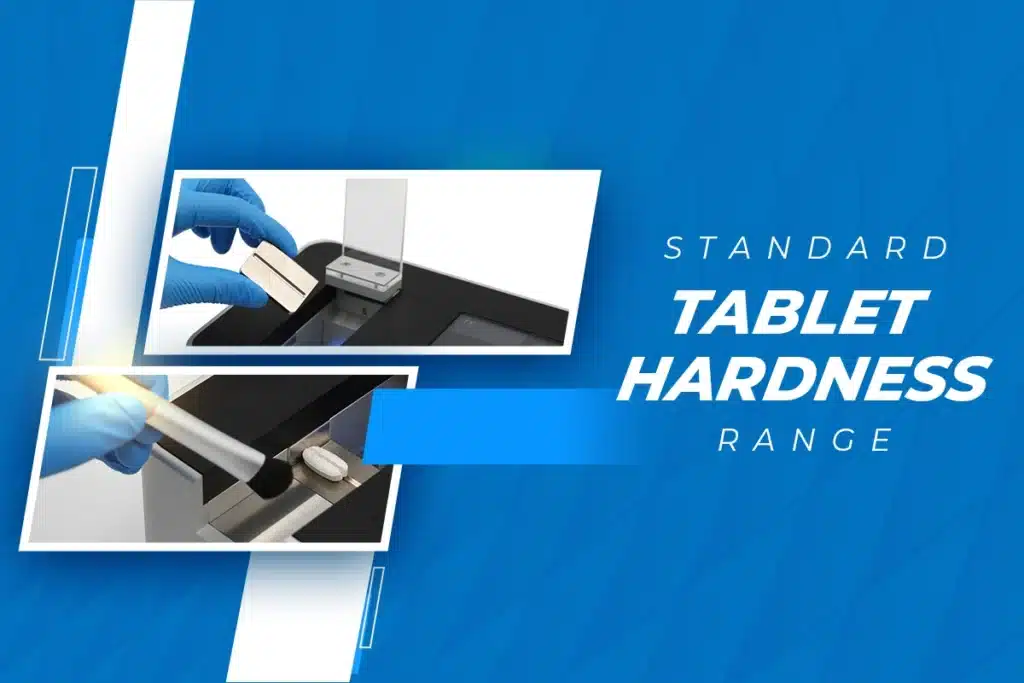
What is Tablet Hardness
Tablet hardness can be defined as the mechanical strength of a tablet, and this can be expressed as the fracture force required to crush a tablet between two anvils. It is a significant factor in pharmaceutical quality, as it affects the tablets directly during coating, packaging, shipping and patient administration.
How Tablet Hardness is Measured
Tablet hardness testing involves the use of a tablet hardness tester. The machine compresses the tablet from both ends until it breaks. The tablet breaking force is then recorded, and this force can be expressed as Newton (N) or kiloponds (kp). The hardness measurement in Newton will then be used to prove that the tablets are within the acceptable tablet hardness range.
Factors Affecting Tablet Hardness Range
Some of the factors which influence the hardness of the tablets include:
- Compression force: The more force used in compression force, the harder it is.
- Binder Concentration: The more binder used in the process, the higher the mechanical strength.
- Moisture content: More or less moisture content makes the tablets weaker or stronger.
- Particle size: The smaller the particles, the harder the tablets are.
- Punch speed: The speed of the punch also affects the tablets, making them weaker if the compression speed is faster, it may reduce hardness.
Why Tablet Hardness Range is Critical
The right range of hardness in the tablets is important. The cause and effects are obvious:
- Low hardness → the tablets are liable to break and chip during the coating and packaging process.
- High hardness → dissolution difficulties occur, which may impair the rate and extent of the absorption of the active ingredients.
By sticking to the standard specifications of tablet hardness, the tablet can withstand the rigours of the tablet-making process and, at the same time, perform the required function.
Minimum vs Maximum Tablet Hardness
Every product has upper and lower limits of tablet hardness values. The minimum tablet hardness ensures that the tablets do not break during handling. Values lower than the minimum cause unacceptable friability of the tablets. The maximum tablet hardness ensures that the tablets disintegrate or dissolve in time. Excessive values cause problems in dissolving the tablets, leading to non-compliance by patients due to difficulty in swallowing the tablets.
Units Used in Tablet Hardness Measurement
Common units of tablet hardness units are Newton (N) and kilopond (kp), where 1 kp is equal to 9.81 N. Many modern instruments also show values in Strong-Cobb (SC) units. Tablet hardness values in Newton units are in accordance with international standards and make data exchange easier in pharmaceutical quality control laboratories worldwide.
Tablet Hardness Range in Manufacturing Process
During the tablet manufacturing process of making the tablets, hardness testing occurs during the process and at the end of the process. The in-process checks occur every 15-30 minutes. The compression force is adjusted according to the hardness range. The hardness range helps in maintaining the mechanical strength of the tablets. The batch is tested at the end of the process to ensure that it meets all the specifications.
Common Problems When Hardness Range is Incorrect
When the tablets do not meet the tablet hardness range, several defects occur:
- Capping: The top of the tablet separates from the body.
- Lamination: The layers of the tablet separate.
- Friability: The low hardness tablet results in the edges becoming broken.
- Dissolution: The high hardness tablet results in the failure of the active ingredients to dissolve.
These issues compromise product quality and can lead to costly batch rejections.
How to Maintain Correct Tablet Hardness Range
For maintaining the optimal tablet hardness, various strategies can be adopted, such as:
- Continuous control of the compression force, which should be adjusted automatically.
- The concentration of the binder should be consistent in the granulation.
- The tablet hardness testers should be validated, with routine calibration.
- The operators should be trained to recognize signs of drift, which should be corrected proactively.
Related Product
Need accurate hardness measurement? Check out our selection of precision tablet hardness testers and tablet hardness testing machines for in-process and final tablet hardness measurement.
Frequently Asked Questions
-
What is standard tablet hardness?
It is the acceptable tablet hardness range defined for a specific product, typically expressed in Newton (N). For many immediate‑release tablets, the range is 40–100 N.
-
What is ideal tablet hardness range?
It should be hard enough not to break but soft enough to disintegrate. The ideal range for tablet hardness for immediate release is between 40-100 N, and for extended release, it should be between 80-150 N.
-
How hard should a tablet be?
Hard enough to resist breakage during packaging and shipping, yet soft enough to disintegrate within the specified time (e.g., 30 minutes for immediate‑release).
-
What happens if tablet hardness is too low?
Tablets that are too soft are prone to chipping, capping, and friability, resulting in wastage and, in the worst scenario, underdosing if the tablet breaks before time for consumption.
-
What happens if tablet hardness is too high?
Tablets that are too hard may result in dissolution problems, delayed drug release, and difficulty swallowing, all of which affect the efficacy of the drug.
-
What units are used for tablet hardness?
Tablet hardness units are measured in Newtons (N) and kiloponds (kp). Some machines are designed to switch units.
-
How often should tablet hardness be tested?
During the tablet manufacturing process, in‑process testing is typically performed every 15–30 minutes. Final batch release requires testing of representative samples per pharmacopoeial guidelines.
Key Takeaways
The tablet hardness of most immediate release tablets ranges from 40 to 100 Newton (N), though this may vary depending on the formulation. It is of utmost importance to maintain the optimal tablet hardness, which should neither be too low, leading to breakage, nor too high, leading to dissolution problems. Tablet hardness testing is essential in maintaining quality throughout the tablet-making process.