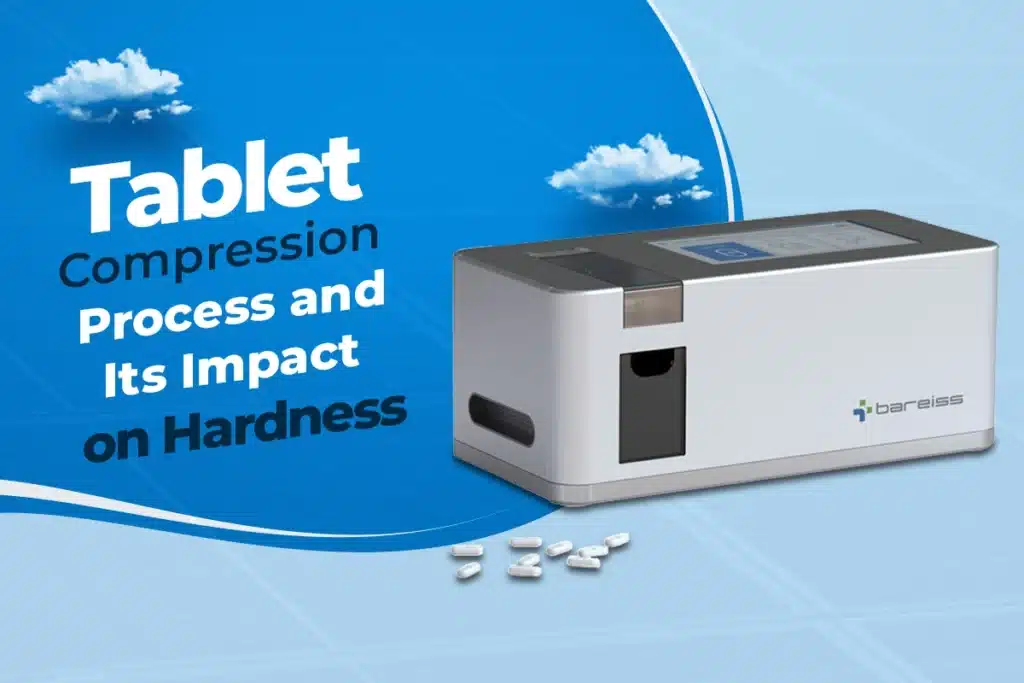
Tablet Compression Process and Its Impact on Hardness
The tablet compression process occurs through the application of mechanical pressure. This compression defines the hardness of the tablet. This must be precise to avoid the breaking or dissolving of the tablet.
Process Summary
Higher compression force increases tablet hardness up to an optimal point; too little causes friability, too much can hinder dissolution.
Tablet Compression Process Flow
Die filling: The die cavity is filled with a precise amount of powder.
- Compression: The punches apply pressure to compress the powder.
- Tablet ejection: The finished tablet is pushed out by the lower punch.
- Hardness testing: The breaking power of the tablet is tested.
Stages of Tablet Compression
The tablet manufacturing process can be divided into three stages, which are unique in nature and impact the quality of the tablet.
Die Filling
The lower punch moves down to make a cavity in the die, which is then filled with granules or powder.
Compression Phase
The compression phase involves the application of compression pressure by the upper and lower punches. This compression results in the formation of bonds between the powder particles, which defines the hardness of the tablet.
Ejection Phase
After compression, the upper punch retracts, and the lower punch rises for tablet ejection. The finished tabletbis then pushed out of the die and swept onto a conveyor.
How Compression Force Directly Affects Tablet Hardness
The relationship between compression forces and tablet hardness is direct. Low compression forces will not bond sufficiently and will produce weak and friable tablets. Optimum compression forces will produce maximum inter-particulate contact and produce the optimum tablet hardness for coating and packaging. Understanding how compression affects tablet hardness is essential for balancing mechanical strength with drug release.
Relationship Between Compression Force, Density, and Hardness
With increased compression pressure, density is increased in a tablet as air is pushed out, and particles are pressed plastically. This improves bond strength as a result of increased surface area of contact. The relationship between tablet density and hardness in a tablet is a basic principle, whereby increased density in a tablet generally translates to increased hardness, provided the formula is optimized.
Factors in Compression That Influence Hardness
- Compression pressure – primary driver of bonding.
- Granule size – smaller granules enhance strength.
- Binder concentration – more binder generally increases hardness.
- Moisture content – optimal levels aid plasticity.
Compression Defects That Impact Tablet Hardness
Mechanical problems with compression directly affect the quality of a tablet. Tablet capping happens when there is separation at the top or bottom of a tablet, typically due to air getting trapped in the powder. Tablet lamination happens when a tablet splits completely. These compression defects reduce effective hardness and can cause batch rejection.
Impact of Over‑Compression vs Under‑Compression
This under-compression results in a product with low hardness, which is liable to break during handling. On the other hand, over-compression causes a compacted product, which affects its dissolving properties, resulting in a long disintegration time.
Tablet Hardness Testing After Compression
After the tablet compression process, tablet hardness testing verifies mechanical strength. Tablets are crushed diametrically to measure the tablet breaking force. This test is performed in-process to allow immediate adjustments and at batch release to confirm uniformity.
Role of Compression in Pharmaceutical Quality Control
Pharmaceutical quality control involves monitoring the process steps of tablet compression. This is a critical control point for pharmaceutical companies. Tablet hardness, tablet weights, and tablet thickness are checked to ensure that the press is working within validated parameters.
Optimizing Compression Parameters for Target Hardness
Optimizing tablet hardness involves several key parameters. Formulation control is a key factor in tablet production. The size of the granules and the concentration of the binder and moisture levels must be controlled before compression. Process control involves the main compression force, precompression, and turret speed. Real-time data provides operators with information needed to maintain the required tablet hardness throughout the process.
Real‑World Example of Compression Impact on Hardness
The company that made a tablet of 500 mg and adjusted the compression pressure from 12 kN to 18 kN to correct the friability problem saw an increase in tablet hardness from 5 kP to 9 kP, which eliminated tablet breakage. However, a 20% decrease in dissolution resulted in a return to a moderate pressure.
Related Product
Need accurate hardness measurement after compression?
Our tablet hardness tester delivers precise, repeatable results. Explore the tablet hardness testing machine trusted by quality control labs worldwide.
Frequently Asked Questions
What is tablet compression process?
It is the step where powder is compacted between punches inside a die to form a solid tablet.
How does compression affect tablet hardness?
Compression force bonds particles together; a higher force generally increases hardness until the point of over‑compression.
What is compression force?
It is the mechanical pressure applied by punches, measured in kilonewtons (kN), that determines tablet density and strength.
Why tablet hardness is important?
It ensures tablets survive coating, packaging, and shipping while still disintegrating properly in the body.
What is compression force vs hardness?
Compression force is the input pressure; hardness is the resulting breaking force. The two have a direct, non‑linear relationship.
What is the effect of compression on tablet hardness?
Increased compression force raises tablet hardness by improving inter‑particulate bonding, up to an optimal limit.
Key Takeaways
The process of tablet compression directly affects the hardness of a tablet in pharmaceutical manufacturing. Balancing compression force in a tablet prevents breakage and dissolving issues in a drug product. Tablet hardness tests are conducted uniformly, while quality control in a drug product validates each step in its manufacture.